

The fitting is only part of the cost. For outdoor LED lighting installation in Werribee, access, existing circuits and available switchboard space are key factors. Hardwired outdoor lighting in Victoria must be installed by a licensed electrician, while a plug-in 12-volt garden lighting kit can be fitted by a homeowner.
It’s understandable to want a clear idea of the work and cost before choosing lights. The price depends on the project and is given after a quote request, with cable routes, trenching, installation requirements and any repairs shaping the job.
This guide explains when to use an electrician, how low-voltage and mains-powered options differ, and what can affect an installation. You’ll also learn how cable routes and landscaping are considered, what to do when an outdoor light needs attention, and how to plan lighting for your garden and home.
Key Takeaways
- Use a plug-in 12-volt garden lighting kit for a simple DIY setup; hardwired outdoor lighting in Victoria requires a licensed electrician.
- Plan for access, existing circuits and switchboard space to influence the scope of wall, porch, pillar and flood light installations.
- Consider cable routes and garden layout early, as the electrical supply and route determine whether trenching is needed.
- When outdoor lights need installation or repairs, an electrician can assess the wiring and help ensure the setup suits the location.
Do I need an electrician for outdoor lighting in Melbourne?
Hardwired outdoor lighting in Victoria must be installed by a licensed electrician. A plug-in 12-volt garden lighting kit is a homeowner option.
Compliance and safety certification
Moving a garden light may involve electrical work, so consider getting professional advice. A transformer wired into the electrical supply must also be installed by a licensed electrician. Separate houses accounted for 85% of homes in Werribee, Victoria, according to the Australian Bureau of Statistics. For homes with garden paths or outdoor entertaining areas, the lighting plan should account for the wiring route and how switches operate the lights. These details help define the electrical work required.
For outdoor LED lights and wiring, the key rule is that hardwired installations need a licensed electrician. A homeowner can fit a plug-in 12-volt garden kit, but wiring work is different.
Installation testing and documentation
For prescribed electrical work, the attending electrician is responsible for issuing the Certificate of Electrical Safety (CES). It documents the prescribed work, while testing helps assess whether the lighting and electrical connections operate as intended. The electrician can consider the circuit, switches, transformer and fittings as part of the completed setup. Keep the certificate with your household electrical records, especially if future work affects the same circuit.
Common installation risks
Common mistakes include attempting hardwired work without an electrician, choosing a fitting unsuited to its location, or placing lights where glare spills towards adjoining windows, roads or shared areas. Motion sensors may also trigger unnecessarily if they detect street movement. Position sensors to cover the area they need to monitor.
There is no single IP rating or waterproofing choice for every outdoor position. Select fittings suited to the location and conditions, and follow the manufacturer’s instructions. In Werribee, consider exposure to rain, irrigation and direct weather. Shelter alone doesn’t make an indoor fitting suitable. For coastal exposure, choose a fitting whose instructions cover those conditions. These checks help match the fitting to the site, rather than relying on appearance alone.
What Affects Outdoor Lighting Costs?
Outdoor lighting installation involves more than choosing fittings. The type of light, access, existing circuits and available switchboard space all affect the work.
Outdoor fitting choices
Wall and porch lights usually illuminate entrances, while pillar lights mark gates or paths. Floodlights cover broader areas, such as a driveway or rear garden. The fitting’s position and mounting surface affect access and installation. A new light point may also need a different cable route from a replacement in the same position.
The price depends on the job and is provided after a quote request. Access, existing circuits, switchboard space, cable routes and the number and placement of fittings all affect the scope.
Replacing halogen floodlights with LED fittings can reduce power use compared with older halogen floodlights. When planning a replacement, an electrician considers the existing mounting, wiring and sensor. Reusing a suitable position may avoid creating a new light point, while changing the location can add electrical work.
Planning lighting by area
Plan paths, garden beds, driveways and entry points separately. Pathway bollards can guide movement along garden routes, while a porch or wall fitting lights the entrance. For a driveway, direct floodlights towards the area that needs coverage, not adjoining windows or the road. This balances visibility with glare control.
Sensor lights suit locations where light is needed in response to movement. Position sensors to detect the intended approach, accounting for nearby street movement that could cause unwanted triggers. Security floodlights can also complement video surveillance technology. Discuss the coverage area and sensor direction during planning, then decide whether existing fittings can be replaced or the entire layout needs a new approach. LED lighting upgrades can help with planning a coordinated replacement.
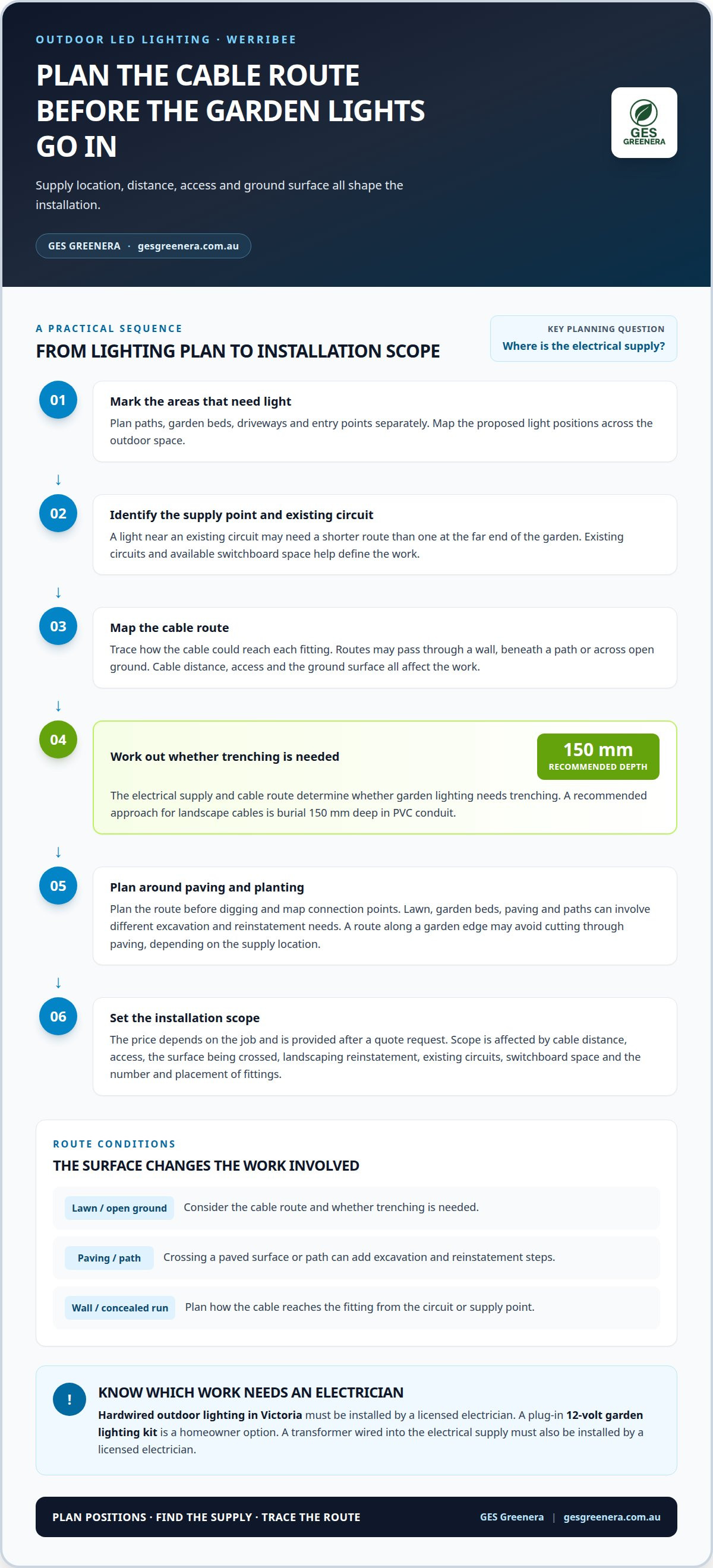
Cable routes, trenching and landscaping
The electrical supply and cable route determine whether garden lighting requires trenching. In Werribee, a light near an existing circuit may need a shorter route than fittings at the far end of a garden. Distance, access and ground surface all affect the work. Routing a cable beneath lawn differs from crossing paving, a garden bed or a path, where excavation and reinstatement may add steps.
For landscape cables, a recommended approach is burial 150mm deep in PVC conduit. The route should be planned before digging, with the light positions and connection points mapped across the outdoor space. That makes it easier to account for existing landscaping and reduce unnecessary disruption. For example, a route along a garden edge may avoid cutting through a paved area, depending on the supply location.
Longer cable runs can affect the installation because each light must connect to a suitable supply. A route may pass through a wall, beneath a path or across open ground, with each option changing access and reinstatement needs. Exterior downlights also need a cable route from the circuit to the fitting. In Melbourne and across Victoria, weather exposure is another practical consideration when planning outdoor cable routes.
The price depends on the case and is given after a quote request; cable distance, access, the surface being crossed and any landscaping reinstatement affect the scope. Before work begins, the installer can map the proposed garden lighting positions, identify the supply point and plan where trenching or concealed cable runs are needed. This step helps organise an efficient route around existing paths and planting, while keeping the installation suitable for the site.
For a practical layout, decide which areas need light before fixing cable routes. Marking positions for path fittings, garden features and exterior downlights shows whether the planned run reaches each point. A clear route also helps avoid placing fittings where later landscaping could disturb the cable.
Outdoor lighting installation and repairs
Outdoor LED lighting installation and repairs in Werribee can involve layout, fitting placement, wiring, testing and fault diagnosis. A repair starts by identifying whether the issue involves a lamp, sensor, transformer, cable or electrical supply.
For a new landscape, the lighting plan should match each feature to its purpose. Pathway bollards can be spaced 1-2 metres apart along garden routes, while feature lights can highlight planting or an entertaining area. A 12 V low-voltage system uses a transformer to step down mains power. A 240 V garden system may suit larger fittings or lights further from the house.
Transformer capacity matters when adding fittings. For example, a 100W low-voltage transformer running ten 8W lights is at capacity. Adding another fitting without accounting for the combined load can exceed that capacity. A lighting plan should consider the existing transformer, wiring and intended light positions before expanding the system.
Repairs may involve tracing a fault through the existing setup rather than replacing every fitting. An electrician can inspect the lamp, sensor response, transformer and visible wiring, then test the relevant electrical circuit. If a motion sensor responds to street movement, adjusting its position may help. If one section of garden lighting stops working, the fault may be local to its cable or connection.
Outdoor fittings need to suit their actual exposure and the manufacturer’s instructions. A fitting sheltered under an eave still needs to be appropriate for its location. Good placement also limits glare and spill towards adjoining windows, roads and shared areas. For an upgrade, assess the existing layout first, then decide whether to repair individual points or reorganise the landscape lighting.
For help planning an installation or diagnosing an outdoor lighting fault, arrange an outdoor lighting assessment.
GES Greenera: LED Lighting Upgrades
GES Greenera provides outdoor LED lighting upgrades for homes, from replacing existing fittings to addressing lighting faults. Turn to the team when you’re ready to install garden or security lights, update older fittings, or need electrical repairs related to outdoor lighting. The right approach depends on the layout, existing wiring, cable routes and the areas you want illuminated. Details about the lights and any faults can help shape the next steps. GES Greenera also provides residential electrical repairs for household lighting issues. Contact the team for a free, no-obligation quotation for your outdoor lighting project.
Plan your outdoor lighting next step
Decide what you want from your outdoor space before settling on a lighting layout. A clearer entrance, a well-lit path or a more usable entertaining area may each call for a different approach. For outdoor LED lighting installation in Werribee, describe the area, the lighting outcome you want and any existing fault or fitting that needs attention.
GES Greenera can discuss your lighting needs alongside its Residential Electrical Repairs, Commercial Switchboard Upgrades and Solar PV System Installation services. This broader electrical capability can be useful when outdoor lighting forms part of a wider electrical project. Share what you’re planning, and the team can help establish the relevant next steps for your project. Contact GES Greenera about outdoor lighting and take the next step towards a setup that suits your home.
Frequently Asked Questions
How many path lights do I need for a front garden?
Plan the number around the path’s length, bends and areas needing illumination. Pathway bollards are advised at 1-2 metres apart along garden routes. Mark the walking line and note steps and entry points, then space fittings to guide movement without crowding the garden. Planting beds or a driveway may need separate feature lighting rather than additional path lights.
What is the typical cost to install outdoor LED lights in Werribee?
The work depends on the fittings, existing electrical supply, access and installation requirements. Replacing a fitting in an accessible position differs from adding a new light point across a garden. Cable routes, trenching and switchboard space can also affect the scope. GES Greenera provides free, no-obligation quotations, with project details shaping the proposed work.
What are outdoor LED lighting installation labour and materials prices in Melbourne’s west?
Labour and materials depend on the project rather than a standard package. Labour may be affected by access, wiring requirements and whether the route crosses paving or garden beds. Materials depend on the selected fittings and components needed for the layout, such as cable or a transformer. GES Greenera provides free, no-obligation quotations so these requirements can be considered together.
What are the licensed electrician requirements for outdoor lighting installation in Victoria?
Hardwired outdoor lighting in Victoria must be installed by a licensed electrician. A plug-in 12-volt garden lighting kit can be fitted by a homeowner, but moving a 240-volt garden light requires new wiring. For prescribed electrical work, the attending electrician is responsible for issuing the Certificate of Electrical Safety. GES Greenera states its electrical work complies with AS/NZS 3000:2018.


