

Most residential streets in Williamstown are described as single-phase, and that supply can support EV charging at up to 7.4 kW. For Tesla EV charger installation in Williamstown, this means a home charger can suit many local properties without three-phase power. Three-phase supply can charge faster, but it isn’t essential for home charging.
It’s reasonable to wonder whether your home’s power supply will limit your charging options, or whether a standard 10A power point will do the job. This guide explains how single- and three-phase power affect charging, what influences installation cost, and how a dedicated charger compares with a power point.
You’ll also learn what an installer considers when planning the circuit and charger location, so you can understand the practical choices before deciding on a home setup.
Key Takeaways
- Many Williamstown homes have single-phase power, which can support home charging at up to 7.4 kW. Three-phase supply can offer faster charging, depending on the vehicle and charger.
- Installation costs depend on factors such as switchboard condition, charger location and the work needed to run a dedicated circuit.
- A 10A power point can suit occasional charging, while a dedicated charger is designed for more regular home charging.
- Compare your home's power supply, driving routine and vehicle charging limits to choose a setup that fits your needs.
How much does an EV charger cost to install in Williamstown?
For Tesla EV charger installation in Williamstown, the final price depends on your home’s switchboard, circuit route and charger location. Home charging costs also depend on your electricity tariff and whether you can use solar power.
See a Tesla Wall Connector installation example, including its dedicated circuit and surge protection:
Home Charger Installation Costs
Installation pricing reflects the equipment and electrical work, not just the wall-mounted charger. The price depends on the property and is provided in a free, no-obligation quotation. Key cost factors include switchboard condition, cable distance, mounting position and any upgrades needed.
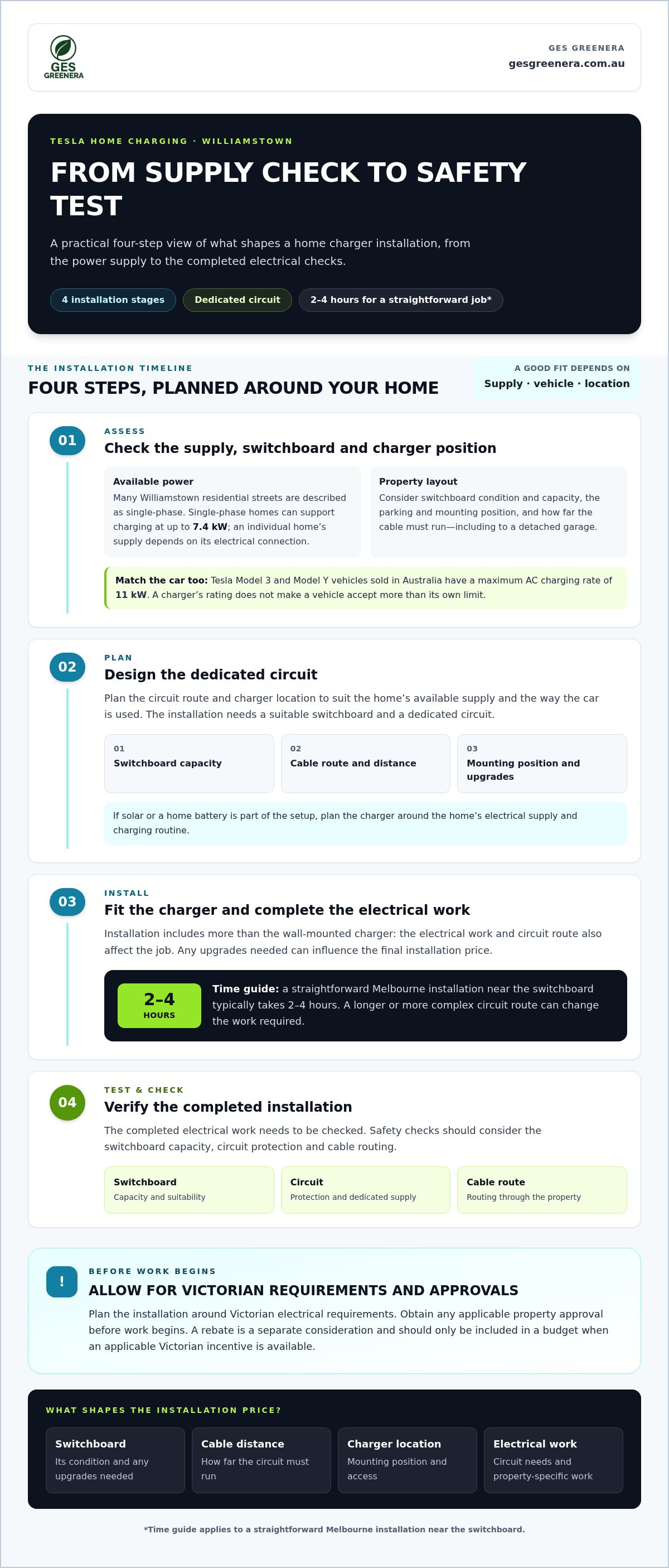
For a Tesla Model 3 Performance, compare charger output with the vehicle’s AC charging limit. The Australian Model 3’s maximum AC charging rate is 11 kW, while the Tesla home charger listed for Williamstown is rated at 7.4 kW. Installation typically takes 2-4 hours when the location is straightforward and near the switchboard.
Home Charging Costs
Your charging spend depends on energy use and your electricity plan, so compare off-peak rates when choosing charging times.
To integrate solar or a home battery, plan the charger around your home’s electrical supply and charging routine.
Victoria Rules and Permits
Plan the installation around Victorian electrical requirements and obtain any applicable property approval before work begins. A safe installation needs a suitable switchboard, a dedicated circuit and checks of the completed electrical work.
The practical steps are to assess the supply and charger position, plan the circuit, install the equipment, then test it. Safety checks should consider switchboard capacity, circuit protection and cable routing. Allow 2-4 hours for a straightforward Melbourne installation near the switchboard. Treat a rebate as a separate consideration, and include one in your budget only when an applicable Victorian incentive is available.
Is Williamstown single or three phase?
Williamstown’s residential streets are described as single-phase, and single-phase homes can support EV charging up to 7.4 kW. Three-phase supply can allow faster charging, but the vehicle and charger determine how much power the setup can use.
Williamstown is on the Jemena network, but an individual home’s supply depends on its electrical connection. A Tesla Wall Connector installation requires an assessment of your available capacity, switchboard and proposed circuit. The charger’s rating must also suit the supply and the vehicle’s charging limit.
A Tesla Model 3 or Model Y sold in Australia has a maximum AC charging rate of 11 kW. That matters when comparing supply options: a higher-rated charger cannot make a vehicle accept power beyond its own limit. On three-phase power, an EV charger can charge up to three times faster than a single-phase charger, depending on the vehicle and charger.
Three-phase power can support a 22 kW charger, which can deliver about 120 km of range per hour. That figure describes the charger’s potential, not a guaranteed rate for every vehicle. For a Tesla with an 11 kW maximum AC rate, the vehicle remains the limiting factor when the charger offers more capacity.
For home EV charging, weigh your regular driving needs against the cost and practicality of the available supply. Single-phase at 7.4 kW can suit overnight charging, while three-phase may help drivers who need quicker turnarounds and have a compatible vehicle. Fast charging also depends on the connector, charger settings and vehicle battery. An electrical assessment can clarify the right arrangement for your property. Explore EV charging station installation for help planning a suitable setup.
10A power point versus dedicated charging
A standard 10A power point can work for occasional electric car charging in Australia. It uses a portable EVSE cable plugged into a three-pin outlet, making it a straightforward option when daily driving is limited. For owners who charge regularly, it may not be the most practical long-term arrangement.
A dedicated home EV charger uses its own circuit and can deliver power faster. A 7.4 kW charger adds roughly 40 to 50 km of range per hour, while a 7 kW AC charger can add up to 40 km per hour. The vehicle’s charging limit still matters, so match the charger to your car.
The difference shows up over a charging session. A 7 kW charger operating for two hours delivers charging at that stated power for that duration, subject to the vehicle’s limits. A Level 2 home charger takes approximately half the time of a Level 1 charger to achieve a full charge. Actual charging time varies with battery size and starting charge.
A dedicated charger can add a substantial load to the home’s electrical supply. That makes the circuit and switchboard important parts of choosing the correct setup, not just the charger itself. An electrician can assess the supply and plan the circuit to suit the property and the vehicle.
For a Melbourne driver who plugs in occasionally and has time to recharge, a 10A outlet may meet their routine. Regular commuters may prefer dedicated charging for quicker top-ups at home. Compare your daily driving distance, parking arrangements and vehicle’s AC charging capacity before choosing. The right option is the one that fits how you use your electric car, rather than simply selecting the highest charger rating.
Licensed EV charger installers near Williamstown Victoria
A Tesla charger installation involves more than mounting a connector. In Williamstown, your home’s supply, switchboard, cable route and parking position need to be assessed before work is planned. Choose a licensed electrical professional experienced with EV charging to ensure the installation and safety checks are handled together.
A useful first step is an on-site assessment. It can identify whether the charger can sit near the switchboard or needs a longer circuit run, such as to a detached garage. The available supply and the vehicle’s AC charging limit also shape the setup. A straightforward installation near the switchboard typically takes 2-4 hours; a more involved cable route changes the work required.
Look for a clear installation plan covering the practical details, not just the charger. It should account for:
- Switchboard capacity and the proposed dedicated circuit.
- RCBO or RCD protection and testing after installation.
- Charger position, cable route and access to the vehicle’s charge port.
- Electrical safety documentation following the completed work.
A documented installation example in Victoria included a dedicated circuit, RCBO/RCD protection and a Certificate of Electrical Safety. These details show why electrical work and completion checks matter as much as the Tesla Wall Connector itself. The charger’s location should also allow convenient daily access without stretching the cable across a vehicle path.
Installation availability in Williamstown is typically within 1-2 weeks. Before work begins, have the charger model, vehicle and preferred parking position ready to discuss. That information helps shape a suitable plan for the property, including any switchboard work or circuit changes. For a home charging setup, arrange EV charger installation as the next step.
GES Greenera: Residential Electrical Repairs
GES Greenera installs EV charging stations for homeowners planning Tesla charging at home. If your switchboard needs attention before adding a charger, residential electrical repairs can address issues that affect the installation. Solar PV system installation may also suit homes combining an EV charger with rooftop generation.
The right next step depends on your property’s supply, switchboard condition, charger position and preferred charging routine. Discussing these details helps tailor the installation to your home and vehicle, rather than choosing equipment in isolation. GES Greenera also handles commercial switchboard upgrades for businesses considering EV charging.
For help planning home charging or addressing an electrical issue, contact GES Greenera or visit gesgreenera.com.au.
Plan your next step towards home charging
Treat home charging as part of your household’s electricity use, not simply as a device choice. When arranging Tesla EV charger installation in Williamstown, consider whether future changes to your home energy setup could affect the charger’s position or circuit planning.
GES Greenera provides EV charging station installation, residential electrical repairs and commercial switchboard upgrades. Solar PV system installation may also suit homes looking to align vehicle charging with on-site generation. Planning these together helps you consider current electrical work alongside potential future upgrades.
Share your vehicle, parking layout and household charging routine when you get in touch. Those practical details provide a useful starting point for discussing a setup that suits your property. A clear outline of your priorities can keep the conversation focused on everyday use, not specifications alone. Contact GES Greenera about installation and take the next step towards a home charging plan that fits your needs.
Frequently Asked Questions
Can you run the circuit to a rear laneway garage?
Yes, a dedicated circuit can be routed to a rear laneway garage, with the cable path and property layout shaping the work. In Williamstown, this route is typically a full-day job rather than a half-day installation. The electrician plans how to reach the garage and position the charger, then assesses the switchboard and electrical supply for the added circuit.
Do I need a switchboard upgrade for an EV charger in Williamstown?
Not every Williamstown home needs a switchboard upgrade. The decision depends on the board’s condition, available capacity and the protection required for the new charging circuit. If existing equipment cannot safely support the installation, an upgrade may be needed before the charger is connected. An electrical assessment identifies the work your home needs, rather than assuming every property requires the same changes.
What should you look for in a home EV charger?
Start with compatibility: check that the charger connector suits your vehicle and its charging capacity matches the car’s limits. Consider where the car parks, how the cable will reach its charge port and whether the charger will be exposed to the weather. If you have solar, consider how charging times fit your household’s energy use. A practical setup should suit your everyday parking and charging habits.
What is the Tesla Wall Connector installation cost in Williamstown VIC?
The cost depends on the property and installation requirements, including switchboard condition, circuit route and charger location. GES Greenera installs EV charging stations and provides free, no-obligation quotations. Request a quote for a project-specific price based on the work involved, rather than relying on a figure that may not reflect your home’s electrical setup.
How do I get a Tesla home charger installation quote from a Williamstown electrician?
Contact GES Greenera for a free, no-obligation quotation for EV charging station installation in Williamstown. Share your vehicle and charger details, where the car parks, and whether the charger will be near the switchboard or in a separate garage. This helps a licensed electrician understand your planned installation and the electrical work your property may need.


