

The wall and cable route can matter as much as the outlet itself. The cost of TV point installation in Melbourne depends on how many points you need, the cable run, access through the walls and the property layout. The price depends on the job and is provided after a quote request, with these factors shaping the work involved.
It’s reasonable to want a neat finish without unexpected work behind the wall. This guide explains what affects a TV point installation, how cable can be routed or concealed, and where extra outlets may suit a Melbourne home or business.
You’ll also learn what to consider when planning points in multiple rooms and how the approach can differ between buildings. These details make it easier to compare options and choose a setup that suits your space.
Key Takeaways
- Understand how wall access, cable length and property layout affect the work involved in adding a TV point.
- Explore cable-routing options that can keep a room looking neat while connecting the television to the antenna system.
- Plan extra outlets around how each room is used, and consider how sharing an antenna signal can affect reception.
- Learn why signal testing and the right setup matter for clear free-to-air reception across multiple TV points.
How much does it cost to install a TV point in Melbourne?
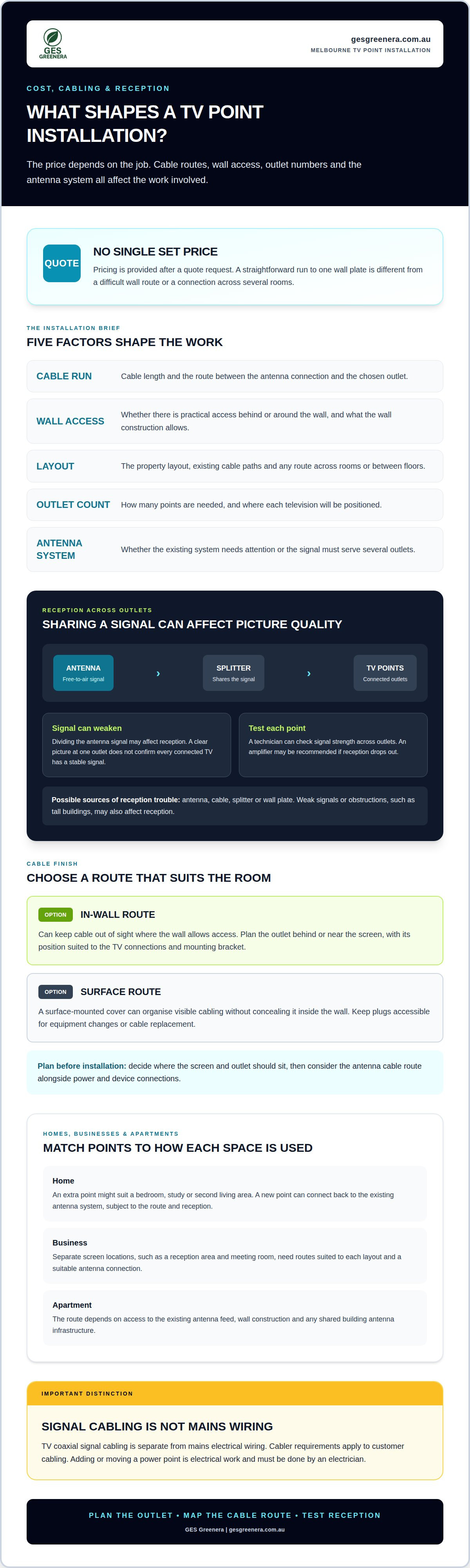
The price depends on the case and is given after a quote request; the main factors are cable length, wall access, property layout, outlet numbers and whether the antenna system needs attention. A straightforward cable run to one wall plate differs from routing cable through a difficult wall or connecting several rooms. During antenna installation, a technician runs the cable, connects it to the TV point and tests reception.
For free-to-air channels such as ABC, SBS, 7, 9 and 10, each television needs a connection to a digital antenna system. A splitter shares the antenna signal across outlets, but dividing the signal can weaken reception. A technician checks signal strength at the points and may recommend an amplifier if the picture drops out. A crystal-clear picture at one outlet doesn’t prove every connected TV receives a stable signal.
Reception problems can start at the antenna, cable, splitter or wall plate. A technician can test the signal at the outlet, inspect connections and compare reception across rooms. In areas affected by weak signals or obstructions, such as tall buildings, a high-gain antenna or amplifier may help. For homes and commercial premises, the number of screens and cable routes shape the installation plan.
Digital TV antenna installation connects the antenna to the home’s outlets. Replacing an existing antenna may be necessary if it is damaged or reception remains poor. Wireless streaming works differently: it delivers content over an internet connection, while an antenna receives free-to-air broadcasts. Depending on viewing needs and available connections, a household can use both.
For TV point work in Victoria, coaxial signal cabling is separate from mains electrical wiring. Cabler requirements apply to customer cabling; adding or moving a power point is electrical work and must be done by an electrician. The right setup depends on whether the job connects an existing antenna, installs a new one or also changes electrical outlets.
Concealing cables for a tidy installation
A concealed route can keep cables out of sight between the antenna outlet and television. For TV point installation near you in Melbourne, the outlet’s position and access to the wall help determine a practical cable route.
Home Access and Cable Runs
Before routing cable, the installer considers the TV location, antenna connection and access behind or around the wall. A short, accessible route may allow a simpler finish than a run across several rooms or between floors. Wall construction and existing cable paths also affect the approach. For example, a bedroom outlet may need a route from the living room’s antenna feed.
Plan extra TV points alongside their cable routes. The installer can assess whether cables can run through the wall or need a surface route, helping you understand the likely finish before work begins. A clear route plan also keeps cable length and outlet placement suited to the room’s layout.
Wall Mounting and Cable Concealment
When mounting a TV, the wall point can sit behind or near the screen to reduce visible cable. Its position needs to suit the TV’s connections and mounting bracket. An in-wall route can provide a neat finish where the wall allows access; a surface-mounted cover offers another way to organise cables without concealing them inside the wall.
For a digital TV setup, plan the antenna cable route alongside power and device connections. A tidy arrangement keeps plugs accessible if equipment changes or a cable needs replacing. Careful placement can help preserve reception while avoiding a loose cable hanging below the screen.
If a wall-mounted television is planned, decide where the screen and outlet should sit before the cable route is finalised. Plan the TV point and cable route together for a cleaner finish and practical access.
Installing additional TV points and outlets in Melbourne homes and businesses
Extra outlets can bring free-to-air viewing to rooms without an antenna connection. The work depends on the number of points and the cable routes required.
Home and Commercial TV Points
At home, an additional TV point might serve a bedroom, study or second living area. In a commercial space, planned outlets can support screens in separate rooms or customer areas. The installer considers where each screen will sit, how cabling can reach it and whether the antenna signal can serve all connected points.
For example, a business with televisions in a reception area and meeting room needs routes suited to both layouts. The number of points and cable runs affects the work involved. Each outlet also needs a suitable connection to the antenna system for the channels viewers expect to receive.
Adding a Point to an Existing Home
To install a new TV antenna point, a technician connects coaxial cabling from the existing antenna system to the chosen room, fits a wall plate and tests reception. The route depends on access through or around the home and the position of existing cabling. A new bedroom outlet, for example, may connect back to an antenna feed elsewhere in the house.
Adding extra TV points may involve splitting the antenna signal between outlets. The technician checks signal strength at the new point and assesses whether the other televisions still receive a clear picture.
Apartment TV Point Installation
Yes, a TV point can be installed in a Melbourne apartment. The route depends on access to the apartment’s existing antenna feed, the wall construction and whether the building uses shared antenna infrastructure.
An installer can assess the intended screen position, available cable path and connection to the building’s TV system. For example, a living-room outlet may be extended to a bedroom if there is a workable route and suitable signal. Planning these details helps match each point to the apartment’s layout and viewing needs.
Before installation, decide which rooms need a connection and where each television will sit. This gives the technician a clear plan for outlet placement, cable routing and testing, whether the project is for a Melbourne home or commercial space.
TV point installation costs in Melbourne
The price depends on the case and is given after a quote request. For a TV point, the main cost factors are the cable route, wall access, property type and number of outlets. A short, accessible run to one room involves different work from routing cabling through several rooms or floors.
Ask for a quote that describes the work included. Clarify whether it covers cabling, the wall plate, connection to the existing antenna system and reception testing. If the job also includes a new TV antenna, replacement equipment or a wall mount, those tasks form part of the scope. A clear description helps you understand what will be completed and the expected finish.
Signal requirements can also change the scope. Connecting extra points may involve splitting the antenna feed, while weak reception can call for further signal testing or an amplifier. An experienced technician assesses the existing setup, cable path and planned outlet positions before confirming the work. The number of points and cable runs also affects the installation.
For example, adding an outlet beside an existing antenna connection differs from running cable to a bedroom on another floor. A commercial installation may need points in separate rooms, with routes planned around the building’s layout. A written scope should distinguish these requirements rather than treating every outlet as the same job. If you need several points, plan their locations together.
Compare the scope, not just a headline figure. Confirm which outlets are included, how cables will be routed, whether reception testing is included and what work may be needed if the existing signal has problems. These details help you assess the proposed installation and finish.
For a quote based on your rooms, cable access and outlet locations, request a TV point installation quote.
GES Greenera: Solar PV System Installation
GES Greenera provides Data and TV Installations for households and businesses planning new points, extra outlets or cable changes. This service suits projects that need a TV connection added or existing cabling adjusted to fit a room’s layout. The work can be planned around screen positions, cable routes and the antenna connection.
For projects beyond television, GES Greenera also provides Solar PV System Installation, EV Charging Station Installation, Residential Electrical Repairs and Commercial Switchboard Upgrades. These services address different electrical needs, so the right option depends on your project.
For help with TV points or another electrical project, contact GES Greenera.
Plan a TV setup that works for your space
A well-planned television setup should suit how each room is used now and leave practical options for future changes. For TV point installation in Melbourne, consider the screen location, the devices you’ll connect and whether your viewing needs may change. A clear plan aligns the outlet, cable route and finished room layout.
GES Greenera provides Data and TV Installations, alongside other electrical services for different project needs. These include Residential Electrical Repairs, Commercial Switchboard Upgrades and Solar PV System Installation. They may suit a wider home or business electrical project.
Share the rooms, outlet locations and installation requirements you have in mind, and take the next step with contact GES Greenera about TV points. A thoughtful plan can make your new setup a better fit for everyday viewing.
Frequently Asked Questions
Can I add TV points in multiple rooms?
Yes, additional TV points can connect televisions in several rooms, such as a lounge, bedroom and study. The installation plan accounts for each outlet and the cabling needed to reach it. GES Greenera serves Melbourne, including Melton, Melbourne Airport, Diggers Rest, Deanside, Bacchus Marsh, Sunbury, Sunshine, Altona, Williamstown, Essendon, Thomastown, Epping, Eynsburry and Werribee.
How long does a typical installation take?
A standard TV antenna installation in Melbourne typically takes 1-2 hours. Adding TV points can take longer or shorter depending on the number of outlets and cable runs. For example, connecting a point close to an existing cable route differs from extending cabling to another floor. The time also depends on the work included, such as replacing an antenna or resolving reception issues.
How quickly can I expect service after my quote?
GES Greenera advertises service availability 24 hours a day, 7 days a week, year-round. This describes availability, not a guaranteed arrival time after a quote. Quotations are free and no-obligation. To help discuss timing, provide the property type, the rooms needing TV points and whether the request also involves an antenna or reception fault.
What does a TV antenna point installation cost in Melbourne?
The work depends on the property layout, cable access, outlet locations and whether the antenna system needs attention. A new point connected to an existing setup has a different scope from work that also addresses an antenna fault. GES Greenera provides a free, no-obligation quotation so you can consider the proposed work before proceeding.
What is included in TV point installation in Melbourne?
TV point installation can include running antenna cable to the chosen location, fitting a wall plate and connecting the point to the TV antenna system. The scope depends on the requested outlet and cable route. A clear quote should state whether reception testing, antenna work or separate electrical changes are included.
How long does TV point installation take in Melbourne?
The time needed to add a TV point depends on the number of outlets and the cabling required for each run. A point near an existing cable route involves different work from one in a distant room or another storey. For multiple outlets, planning their positions together helps establish the full scope before work begins.


