

What if the best commercial solar system for your business isn’t the biggest one that fits on the roof? For Melbourne businesses, a practical system size depends on when you use electricity, as well as your roof, switchboard and grid connection. Assessing those factors before committing helps keep the design grounded in how your site operates.
This 2026 guide explains how to assess whether commercial solar could suit your operations, what shapes system design and how to compare projected savings with the assumptions behind them. It also outlines site checks, installation stages, Victorian incentives and grid-connection considerations.
GES Greenera installs solar PV systems alongside commercial electrical services, including switchboard upgrades. A site-specific approach matters because energy use, electrical infrastructure and connection capacity can all influence system design. Use the steps below to clarify the decisions involved and plan your next move.
Key Takeaways
- Assess whether your business’s daytime electricity use can make practical use of solar generation.
- Understand how roof conditions, shading, electrical infrastructure and grid connection requirements shape system design.
- Compare projected value by separating solar used on site, energy exported and electricity drawn from the grid.
- Plan for key project stages, including a site assessment and any required switchboard work.
Commercial solar in Melbourne: when does it suit a business?
Commercial solar is a business-scale solar PV system designed around the electricity a site uses. Its practical value depends on how well solar generation matches a business’s demand, not simply on how much panel capacity can fit on the roof. Offices, workshops and other commercial buildings can have very different operating patterns and electrical requirements.
Installed capacity describes a system’s potential power at a given moment; electricity generated describes the energy it produces over time. Capacity is commonly expressed in kilowatts (kW), while energy is measured in kilowatt-hours (kWh). For background on photovoltaic systems and other solar technologies, see the Solar Power Overview.
Which Melbourne businesses may benefit from solar PV?
A business that uses more electricity during daylight hours may be able to use more solar generation on site. For example, an office with weekday activity has a different load profile from a workshop operating equipment across extended shifts. Weekend trading, seasonal peaks, quiet periods and planned changes to operating hours also affect how closely demand matches generation.
That match matters when you assess likely value. A broad savings claim may not account for your business’s schedule, tariff, system assumptions or the amount of generation used on site. A site-specific assessment puts those factors in context instead of treating every Melbourne business as if it had the same energy profile. Electrical requirements matter too, which is why solar planning can connect naturally with commercial electrical services in Melbourne.
What should a business assess before exploring solar?
Start by gathering electricity bills and noting when major equipment, lighting and heating or cooling systems operate. Record weekday and weekend patterns, seasonal changes and planned shifts in business activity. Then review available installation space, roof condition and potential shading. These details help frame an assessment, but they don’t determine suitability on their own: the site’s electrical infrastructure must also be considered. A warehouse or workshop in Melbourne’s western suburbs may have different roof and operating conditions from a central office, so the design should follow the actual premises rather than a generic savings estimate.
How commercial solar system design works in Victoria
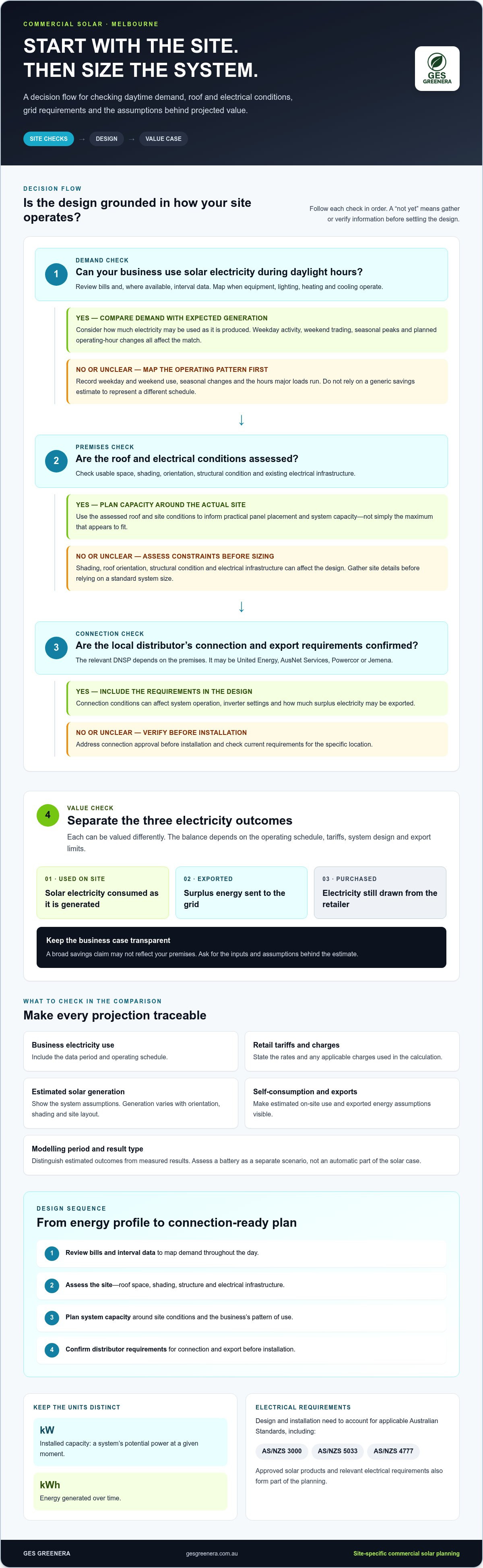
A sound design turns a business’s energy profile and site conditions into a system that can be assessed for connection. The process follows a practical sequence:
- Review electricity bills and interval data to map demand throughout the day.
- Assess the roof, available space, shading, structural condition and electrical infrastructure.
- Plan system capacity around the site conditions and the business’s pattern of use.
- Confirm the local distributor’s connection and export requirements before installation.
Each stage informs the next. Avoid relying on a standard system size or a generic generation estimate when the site and energy profile may differ.
How do energy use and roof conditions shape system size?
Interval data, where available, shows how electricity use changes across the day. Bills provide a broader view of consumption and tariffs. Comparing these patterns with expected solar generation helps assess how much energy the business may use as it’s produced. Panel capacity, measured in kW, and electricity generated over time, measured in kWh, are different design outputs. Actual generation varies with factors such as orientation, shading and site layout, so a projection should explain its assumptions rather than promise a fixed yield.
Usable roof area matters, but it’s not the only consideration. Shading from nearby structures, roof orientation and structural condition can affect where panels can be placed and how much capacity is practical. Base the design on the assessed site, not a one-size-fits-all template.
What do grid connection and export limits mean?
The local distribution network service provider (DNSP) assesses the proposed connection. Depending on the site and network, its requirements can affect system operation, inverter settings and how much surplus electricity can be exported. The relevant DNSP may include United Energy, AusNet Services, Powercor or Jemena, depending on the premises. Address connection approval before installation and verify the current requirements for the location.
Design and installation also need to account for applicable Australian Standards, including AS/NZS 3000, AS/NZS 5033 and AS/NZS 4777, and approved solar products. GES Greenera plans site-specific commercial solar PV installations alongside relevant electrical requirements.
How to assess commercial solar value without relying on generic savings claims
A useful business case separates three outcomes: solar electricity used on site, surplus energy exported to the grid and electricity still purchased from the retailer. Each can be valued differently. The balance depends on your operating schedule, electricity tariffs, system design and any export limits, so a broad savings estimate may not reflect your premises.
Which assumptions should appear in a solar business case?
Ask for the inputs to be clear and consistent. A practical comparison should record:
- Business electricity use, including the data period and operating schedule
- Retail tariffs and any applicable charges used in the calculation
- Estimated solar generation, with the system assumptions stated
- Estimated self-consumption and exported energy, including export assumptions
- The modelling period, with estimated outcomes clearly distinguished from measured results
A battery changes how generation may be used and when electricity is drawn from the grid. Assess it as a separate scenario, not an automatic part of the solar case. If incentives are included, verify current eligibility and scheme rules through official Australian and Victorian program guidance before relying on them.
How can a business compare solar options fairly?
Compare proposals using the same usage data, modelling period and system boundaries. A simple record can use columns for option, self-consumption, exports, grid electricity and assumptions. This makes differences in tariffs, export settings or generation estimates easier to spot, without treating projections as guaranteed results.
Include practical project factors too. Switchboard or other electrical work, possible operational disruption during installation and expected changes in electricity demand can all affect the decision. For residential solar fundamentals, see the Melbourne home solar guide, while keeping business calculations specific to your site.
For a site-specific commercial solar assessment, discuss your business’s solar PV requirements with GES Greenera.
Planning commercial solar installation with GES Greenera in Melbourne
A commercial solar project should start with the business’s priorities and be planned around the actual premises. GES Greenera combines solar PV installation with commercial electrical expertise, so site conditions and electrical requirements can be considered as part of the project.
What happens during a commercial solar project?
Start by outlining the business’s energy use, operating priorities and site requirements. A site assessment then considers the premises, roof conditions, available installation space and existing electrical infrastructure. This helps shape a proposed design for the site rather than assuming a standard system will suit.
The design and relevant distributor connection requirements then inform installation planning. Commercial electrical checks may identify switchboard or other infrastructure work to include in the project plan. Addressing those requirements early gives the business a clearer view of the work involved.
Installation planning should also account for safe site access and the business’s operating hours. A workshop with active production or a customer-facing commercial site, for example, may need installation activities coordinated around access and daily operations. Timing, specifications and expected outcomes depend on the project, so don’t assume every site will follow the same installation schedule.
How can Melbourne businesses take the next step?
Businesses can begin by outlining their site, typical energy-use patterns and project priorities. For premises in Melton, Melbourne Airport, Diggers Rest, Deanside, Bacchus Marsh, Sunbury, Sunshine, Altona, Williamstown, Essendon, Thomastown, Epping, Eynesbury or Werribee, these details help frame a practical discussion about solar PV and related commercial electrical requirements.
GES Greenera provides a coordinated local option for businesses considering commercial solar alongside commercial electrical work, including switchboard upgrades. To discuss your project, Discuss commercial solar for your business.
Set a clear direction for your solar project
Decide what you want your energy investment to support as the business develops. Consider upcoming changes to your premises or operations, and which electrical priorities should be planned together. This gives the project a useful starting point without locking you into a system before the site and business needs have been considered.
GES Greenera’s commercial solar PV installation and commercial switchboard upgrade services bring relevant solar and electrical planning into the same conversation. With a clear picture of your priorities, you can explore a site-specific commercial solar project and its practical next steps.
Ready to explore what could suit your business? Discuss commercial solar for your business with GES Greenera.
Frequently Asked Questions
Is commercial solar worth it for a Melbourne business?
It can be worthwhile where a business uses a substantial share of its electricity during daylight hours, but the result depends on its tariff, operating pattern and project costs. Check whether regular daytime loads, such as refrigeration or production equipment, coincide with solar output. A business in Melton or Sunshine should assess its own site data rather than rely on another company’s headline savings figure.
How much roof space does a commercial solar system need?
There isn’t one roof-area figure that suits every commercial system. The space required depends on the proposed capacity and how much of the roof is usable. A site assessment considers orientation, shading, roof condition, obstructions and layout, since total roof area isn’t the same as clear panel space. For example, a warehouse in Werribee may have a broad roof, but equipment or shading can affect suitable panel placement.
Do businesses need a battery with commercial solar?
No, a battery isn’t essential for every business. It may be worth assessing if the site uses more electricity outside solar generation hours or if export limits affect how surplus energy can be used. Compare a solar-only case with a separate battery scenario using the business’s actual demand and tariff. Eligible battery installations between 5 kWh and 100 kWh may qualify for federal STCs, with the rate scheduled to change on 1 January 2027.
How long does commercial solar installation take?
There’s no single installation timeframe for every commercial site. Project timing can depend on design complexity, distributor connection approval, switchboard or infrastructure work, equipment access and how installation activities fit around business operations. A smaller, straightforward site and a larger or more complex premises won’t necessarily follow the same schedule. A project plan should set out the stages and timing for the actual site.
Are there Victorian rebates for commercial solar in 2026?
Yes, eligible businesses may be able to access federal STCs and Victorian VEU discounts. In 2026, federal STCs apply to eligible solar PV systems up to 1 MW installed from 1 October. VEU discounts apply to eligible 30-200 kW systems at non-residential premises, subject to requirements including a minimum 30 kVA inverter and a VEU-accredited provider using approved products. VEU can combine with STCs. Solar Victoria’s Solar for Business rebate and loan have closed. Check official scheme guidance for current eligibility.


