

What if the right solar system for your home isn’t simply the biggest one that fits on the roof? A well-planned home solar installation starts with your roof, your household’s energy use and your electrical setup, so the system suits the way you live.
It’s understandable to wonder whether your roof is suitable, how much disruption installation involves and what needs to happen before your system can connect to the grid. These are practical planning questions. Working through them early helps you understand what the project involves.
In this guide, you’ll learn what to expect from the initial assessment through to installation and commissioning. We’ll look at how roof space, shade, energy use and switchboard capacity can shape a system design, and why network connection approval is part of the process.
With practical criteria to help you compare options, you can make a more informed next step. GES Greenera installs residential solar PV systems across Melbourne’s west, including Melton, Sunbury, Bacchus Marsh and Werribee.
Key Takeaways
- Assess roof condition, orientation, shade and usable space alongside your household’s energy needs to understand whether solar may suit your home.
- Know what to expect at each stage of a home solar installation, from assessment and design to connection steps, testing and handover.
- Use your daytime electricity use, high-use appliances and future electrification plans to guide system design discussions.
- GES Greenera’s residential solar PV installation service brings home-specific and electrical planning together for homeowners across Melbourne’s west.
Is your Melbourne-west home suitable for solar installation?
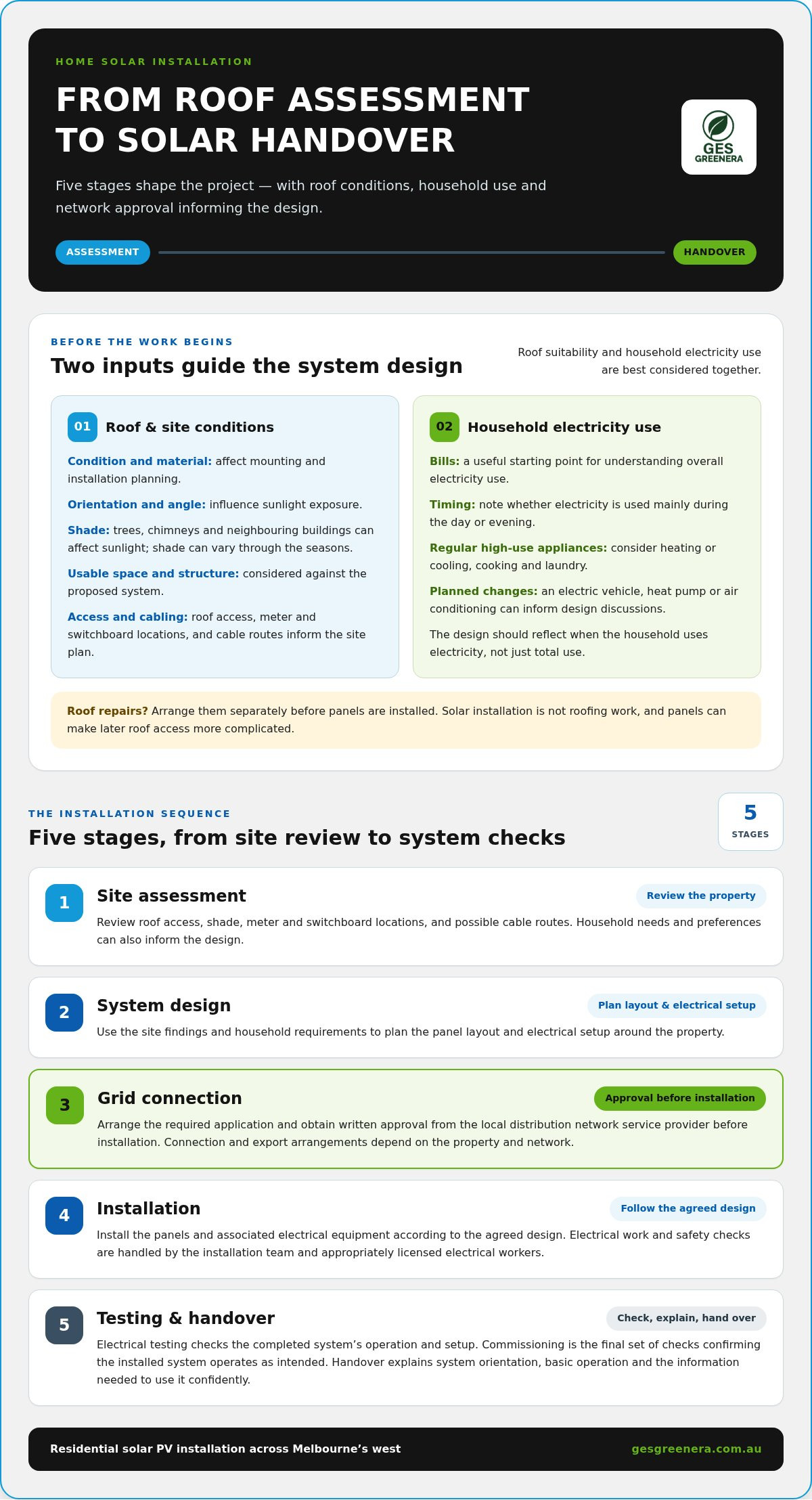
Roof suitability and household electricity use are best considered together. A roof may have usable space, but the design also needs to reflect when your home uses power. Reviewing both helps show whether a proposed system could suit your property and routine.
Rooftop solar suitability depends on the roof’s condition, orientation, shading, usable space and structure, considered alongside household electricity use.
For an overview of the equipment and layout involved, see Rooftop solar power systems. For your home, focus on where panels could sit, what might shade them and whether the roof can accommodate the installation.
Which roof conditions matter before solar panels go up?
Roof material and condition affect how panels can be mounted and how the installation is planned. The roof’s angle and orientation influence its exposure to sunlight, while trees, chimneys or neighbouring buildings may cast shade. In Melbourne’s west, the sun’s position changes through the seasons, so a shaded area at one time of year may receive more sun at another.
Usable space and roof structure matter too. An assessment considers the available area and whether the structure is suitable for the proposed system. If the roof needs repairs, arrange those separately before panels are installed. Solar installation isn’t roofing work, and installing panels over a roof that needs attention can make future access more complicated.
How does household electricity use affect solar suitability?
Your electricity bills are a useful starting point. Review them to understand your overall use, then note when major appliances run. A household that uses more electricity during the day has a different pattern from one where most people are out until evening. This information helps shape a design around your home rather than a generic assumption.
Note regular use from heating or cooling, cooking and laundry appliances. You don’t need to calculate a system size yourself. Matching the roof assessment with your real usage patterns gives the installer a clearer basis for planning a home solar installation.
What happens during a home solar installation in Victoria?
A home solar installation moves from property assessment through design, installation and checks of the completed system. You can explain your household’s needs and preferences, such as areas of the roof you have in mind. System design, electrical work and safety checks are handled by the installation team and appropriately licensed electrical workers.
- Site assessment: Review roof access, shade, meter and switchboard locations, and possible cable routes.
- System design: Use the site findings and household requirements to plan the panel layout and electrical setup.
- Grid connection: Arrange the required application and obtain written approval from the local distribution network service provider before installation. Connection and export arrangements depend on the property and network.
- Installation: Install the panels and associated electrical equipment according to the agreed design.
- Testing and handover: Check the completed system and explain its setup and operation.
For background on the Australian clean energy industry, the Clean Energy Council Australia provides industry information. Property-specific network requirements can affect the connection process, so include these steps in the project plan.
What happens at the solar site assessment?
The assessment looks beyond the roof. Roof access, seasonal shade, meter and switchboard locations, and practical cable routes can all shape the design. For example, the switchboard’s location or a shaded roof area may affect equipment placement or how the work is planned. Share relevant household information and preferences so the design reflects your property.
How are connection, testing and handover handled?
Connection requirements vary by property and network. The application process and written approval need to be addressed before panels are installed; export settings may also depend on network conditions. Once the system is in place, electrical testing checks its operation and setup. Commissioning is the final set of checks that confirms the installed system operates as intended. At handover, expect an explanation of the system’s orientation, basic operation and the information you’ll need to use it confidently. GES Greenera provides residential solar PV installation across Melbourne’s west, including Melton and Werribee, with electrical planning considered as part of the project.
For an overview of GES Greenera’s service, explore GES Greenera’s solar installation service.
How should you plan solar system size and installation in Melbourne’s west?
System design should reflect when your household uses electricity, not just how much it uses overall. Before reviewing proposals, note daytime occupancy, major appliance use and planned changes, such as an electric vehicle, heat pump or air conditioning. These details help make a home solar installation specific to your household rather than based on a generic system-size promise.
| Usage pattern | Design question |
|---|---|
| Someone is home during the day | Which appliances can use solar electricity while it’s being generated? |
| Most electricity use is in the evening | Would changing appliance run times suit your routine? |
| High-use appliances run regularly | How should their timing and electricity needs shape the design? |
| Electrification is planned | How might an EV, heat pump or cooling affect future usage? |
A battery isn’t a requirement for every household. Treat it as a planning option: consider whether storing daytime generation for later use matters to your household and whether future needs could change that decision. For broader context on solar’s potential benefits, see 2026 Melbourne Home Solar Guide: Savings & Sustainability.
What should you compare when reviewing solar system designs?
Look beyond the headline capacity. Compare the proposed panel layout, inverter location and assumptions about your household’s usage. A clear design should explain these choices and show how they relate to your home. Roof space, shade, switchboard arrangements and network requirements can all influence the design, so proposals may differ for practical reasons. If a proposal doesn’t explain its assumptions, ask how the design accounts for your roof and when you use electricity.
Which Victorian incentives or connection rules should you check?
Check Solar Victoria’s current eligibility criteria and terms before factoring an incentive into your plans. Connection requirements depend on the property’s network area. Identify the electricity distributor for your address, then confirm the applicable connection and export requirements for that network rather than assuming nearby homes have the same arrangements.
To discuss a design shaped around your household’s usage and property, read about solar installation with GES Greenera.
How GES Greenera can help with home solar installation
Once you’ve considered your roof, electricity use and future plans, GES Greenera can help turn those details into a practical residential solar PV installation plan. GES Greenera serves Melbourne’s west and nearby areas, including Melton, Melbourne Airport, Diggers Rest, Deanside, Bacchus Marsh, Sunbury, Sunshine, Altona, Williamstown, Essendon, Thomastown, Epping, Eynesbury and Werribee.
A joined-up view of the property and its electrical setup helps inform the installation plan. The proposed panel layout needs to suit the roof, while the switchboard and other electrical requirements are also considered. If you’re thinking about an EV charger or heat pump, noting that early can add useful context to the project.
What should you prepare before discussing your solar project?
A few notes can make an initial discussion more useful. Gather recent electricity bills, any information you have about the roof and a rough picture of when you use power at home. You don’t need to calculate a system size yourself.
- Recent electricity bills that show household usage.
- Roof details you know, including its age, material or any areas that need attention.
- Notes on daytime energy use and when major appliances usually run.
- Planned changes, such as an EV charger or heat pump.
These details help frame a design around your home and routine. For related household electrical context, the Residential Electrician Melbourne guide is also useful alongside solar planning.
What is a practical next step for Melbourne-west homeowners?
Start with your household information and the questions that matter most to you, such as panel placement, switchboard considerations or future electricity use. GES Greenera’s residential solar PV installation service supports homeowners across Melbourne’s west, with the project shaped around the property and its electrical requirements.
Explore home solar installation with GES Greenera to learn about planning a system for your home.
Take the next step towards solar that suits your home
You don’t need to have every technical decision settled before exploring solar. Start with the outcome you want from your home solar installation and the questions that matter most to your household. A clear discussion can help turn those priorities into a practical plan for your property, without assuming every home needs the same approach.
GES Greenera provides residential solar PV installation for homeowners across Melbourne’s west and nearby suburbs. With your household’s priorities in mind, a discussion can focus on how a system could fit your home and electrical setup.
Start planning your home solar installation with GES Greenera. A well-planned project begins with understanding your home and its electricity use.
Frequently Asked Questions
Is my roof suitable for home solar installation?
It may be, but a property-specific assessment is needed before deciding. You can note visible issues such as leaks, damaged roofing or areas that are difficult to access, without trying to diagnose the structure yourself. For homes around Melton or Werribee, photos or available roof plans can provide useful context for an initial discussion.
How long does home solar installation take?
There isn’t one timeframe that suits every project. On-site work is only part of the schedule: design decisions, network approval, installer coordination and access arrangements can also affect when the system is ready. Ask for the expected stages and any dependencies in your project plan. That makes it easier to prepare for installation day without relying on a generic estimate.
Can solar panels power my home during a blackout?
Usually, standard grid-connected solar systems shut down during a network outage, even when the sun is shining. This safety feature helps protect people working on the electricity network. Backup power requires a system specifically designed with compatible equipment; panels alone shouldn’t be assumed to provide it. If you rely on particular equipment at home, raise backup needs during design so the options can be considered.
Do I need a battery with a home solar installation?
No, a battery isn’t essential for every solar setup. Without storage, a home can use solar electricity as it’s generated and draw from the grid at other times. To weigh up storage, consider your evening and overnight electricity needs, whether backup power is a priority, and how your plans might change. Battery suitability and any available support depend on the system and current programme terms.
Are solar rebates available in Victoria in 2026?
Yes, eligible Victorian households may access a Solar Homes Program rebate of up to A$1,400 for solar panels, with a matching interest-free loan also available, subject to current conditions. As of October 2026, eligibility includes a combined household taxable income threshold of A$150,000 and a property value under A$3 million. Check Solar Victoria’s current criteria and application steps before including support in your budget.


