

Choosing a home charger starts with your vehicle, daily driving routine and electrical supply, not the highest capacity on the market. For ev charger installation melbourne, checking how these factors work together can help you focus on equipment that suits your home.
If you’re unsure about compatibility or whether your switchboard can support a charger, you’re not alone. This guide explains how to compare home charging options, what an electrician may check at your property and what to ask before choosing an installer.
You’ll learn how to match a charger to your vehicle and routine, understand the key steps in an installation assessment, and compare proposals with greater confidence. GES Greenera provides EV charging station installation, switchboard upgrades and solar PV installation. A site assessment can help clarify your home’s electrical requirements and whether solar integration is worth discussing.
Key Takeaways
- Choose a charger to suit your vehicle, property and regular driving routine, rather than selecting on features alone.
- Check compatibility and usable charging capacity. Your vehicle and home electrical supply can both limit charging speed.
- Ask the installer to assess switchboard capacity, the cable route, mounting position and conditions at the proposed location.
- When comparing ev charger installation melbourne providers, confirm what equipment, testing and handover are included, and get possible extra work clarified in writing.
EV charger installation in Melbourne: what needs to be decided first?
The right charger depends on your vehicle, property and daily routine. A home EV charger installation involves choosing compatible equipment, checking the electrical supply and site, installing the charger, then testing and commissioning the setup. This guide to ev charger installation melbourne can help you prepare to compare options, but it can’t replace an electrician’s assessment of your home.
A dedicated charger is equipment installed for charging an EV, while a standard power point uses an existing outlet. Their charging capability and suitability can differ, so don’t assume either option will suit every vehicle or property. Ask an electrician which approach is appropriate for your circumstances. For an introduction to charging terminology and AC and DC charging, see these EV charging station basics.
What information should you gather before comparing installers?
Start with your vehicle’s make and model. Check the manufacturer’s information for its AC charging capability and connector requirements. A charger’s advertised capacity alone doesn’t determine how quickly your car can charge.
Make a note of where you park, how long the vehicle is usually parked at home, and whether the parking space is private or shared. These details help an installer understand how you plan to use the charger and whether access arrangements need consideration.
Does your Melbourne property affect the installation?
Yes. The distance from the switchboard to the proposed charger location, the practical cable route and the mounting surface can all affect the installation plan. A clear route and suitable mounting position may simplify planning. Obstacles or limited access should be raised during the assessment.
Homes in Melbourne’s suburbs can have different layouts and existing electrical infrastructure. GES Greenera provides EV charging station installation and switchboard upgrades, so an assessment can help clarify what your property needs before you settle on a setup. If you’re in Melton, Melbourne Airport, Diggers Rest, Deanside, Bacchus Marsh, Sunbury, Sunshine, Altona, Williamstown, Essendon, Thomastown, Epping, Eynesbury (also written Eynsburry) or Werribee, confirm suburb coverage when you enquire.
Compare EV charger installation options by capacity, compatibility and control
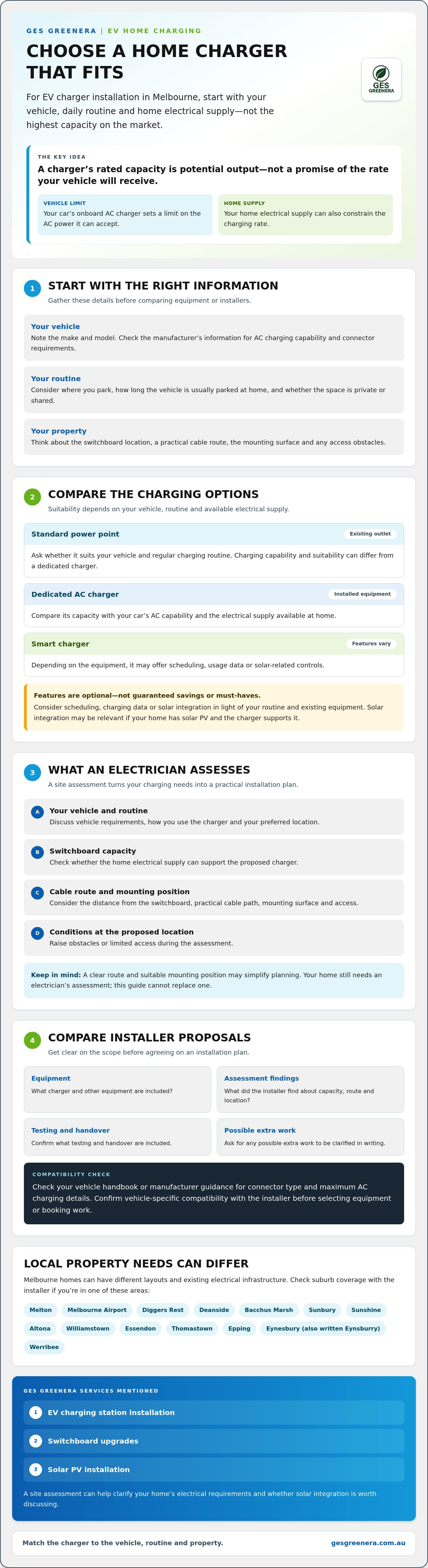
Compare each option with your vehicle’s requirements and the electrical supply available at home. Your car’s onboard AC charger sets a limit on how much AC power it can accept. The home supply can also constrain the charging rate.
A charger’s rated capacity is its potential output, not a promise of the rate your vehicle will receive. The usable rate depends on both the vehicle and home supply, so check each before choosing equipment.
| Option | What to consider |
|---|---|
| Standard power point | Uses an existing outlet. Ask whether it suits your vehicle and regular charging routine. |
| Dedicated AC charger | Installed charging equipment. Compare its capacity with your car’s AC capability and the supply at home. |
| Smart charger | May add scheduling, usage data or solar-related controls, depending on the equipment. |
Which charger features are useful for everyday charging?
Scheduling can be useful if you prefer to charge at particular times, while charging data may help you track use. Solar integration may be relevant if your home has solar PV and the charger supports it. These features are optional, not guaranteed savings or must-haves. For ev charger installation melbourne, weigh them against your routine and existing equipment rather than choosing on features alone.
How do you check vehicle and connector compatibility?
Check your vehicle handbook or manufacturer guidance for the connector type and maximum AC charging details. Confirm vehicle-specific compatibility with the installer before selecting equipment or booking work. If you’re comparing installation approaches, Standards Australia’s guidance on safe and efficient EV charger installation is a useful reference. You can also discuss your home setup and EV charging station installation with GES Greenera.
What happens during an EV charger installation assessment in Melbourne?
An assessment turns your charging needs into a practical installation plan. The electrician should discuss your vehicle, routine and preferred charger location, then inspect the site and check the electrical supply. They’ll consider switchboard capacity, the cable route, mounting position and conditions around the proposed installation. Once you’ve agreed on the scope, installation and testing can follow.
Site conditions determine the final installation scope. The cable route or existing electrical setup may mean additional work is needed, but don’t assume an upgrade is required before an electrician has assessed the property. Ask what has been checked, what the proposed work includes and whether any further electrical work may be recommended.
Which Victorian safety and standards details should you confirm?
Ask how the proposed work will address current Victorian electrical safety requirements and how AS/NZS 3000 applies to your installation. Energy Safe Victoria is a useful point of reference for state-specific electrical safety information. Before proceeding, confirm the installer’s credentials and ask what electrical safety documentation you’ll receive after the work. Requirements can depend on the job, so request clear answers for your circumstances.
What should apartment and townhouse customers ask?
Shared properties need extra planning. Check whether you have the right to use the parking space, whether a cable route through common areas is possible, and what approval the owners corporation or body corporate requires. Clarify who needs to approve the work before arranging installation. This guide to Melbourne apartment versus house EV charging can help you compare property considerations.
For ev charger installation melbourne, a clear site assessment makes it easier to compare proposals on the same basis. You can discuss EV charging station installation with GES Greenera and confirm whether service is available in your suburb.
Choose an EV charger installer in Melbourne and plan your next step
Good installer advice should be specific to your vehicle and property, not just a recommendation for a particular charger. When comparing proposals for ev charger installation melbourne, ask:
- What assessment will be carried out, and what information do you need to provide?
- Is the proposed equipment compatible with your vehicle and home supply?
- What installation work is included, and what could require additional work?
- How will the charger be tested, and what will be covered during handover?
Get the proposed scope and any possible extra work clarified in writing before proceeding. This makes it easier to compare recommendations and understand what remains undecided until the property is assessed.
What should a clear installation quote or proposal explain?
Look for equipment details, the proposed charger location, planned electrical work, testing and handover arrangements. Check the exclusions as well. If the installer can’t confirm part of the scope before inspecting the site, ask what needs to be assessed and how any changes will be explained before work proceeds. Don’t rely on assumptions about what a standard installation includes.
How can Melbourne homeowners take the next step?
Prepare your vehicle make and model, property type, suburb and details of any existing solar PV system. This information can help an installer understand compatibility, access and whether solar integration is worth discussing. For broader context, read the 2026 Melbourne home solar guide or this Melbourne residential electrician guide.
GES Greenera provides EV charging station installation, switchboard upgrades and solar PV installation. Contact the team to discuss your setup, confirm current coverage for your Melbourne suburb and arrange an assessment.
Make your next charging decision with confidence
The right home charger is one that fits your vehicle, charging routine and property. Compare options based on compatibility and usable charging capacity, then ask an electrician to assess the switchboard, cable route and proposed mounting location before settling on an installation plan.
A practical approach to ev charger installation melbourne also means clarifying the work scope, any possible additional electrical work, testing and handover before proceeding. That gives you a clearer basis for comparing installer advice and understanding what your home needs.
GES Greenera provides EV charging station installation alongside switchboard upgrades and solar PV installation. If you’re ready to explore a suitable setup, arrange an EV charger installation assessment with GES Greenera and confirm whether your suburb is currently covered.
With the right questions and a site-specific assessment, you can move towards a charging setup that works for your home and everyday driving.
Frequently Asked Questions
Can I install an EV charger at home in Melbourne?
Yes, many homes can accommodate an EV charger, but suitability depends on your vehicle, parking arrangement and electrical installation. Before ev charger installation melbourne, an electrician should assess the switchboard, supply, cable route and proposed charger location to confirm the scope. Apartment and townhouse residents should also check parking rights and owners corporation requirements. GES Greenera lists service locations including Melton, Sunbury, Sunshine and Werribee. Confirm current suburb coverage before arranging an assessment.
Do I need a switchboard upgrade for an EV charger?
Not necessarily. An upgrade or other electrical work may be needed depending on your existing switchboard, available capacity, charger requirements and household loads. A site visit lets an electrician assess these factors before recommending work. Don’t assume an upgrade is required, or that it can be ruled out, without checking the property’s electrical setup. Ask the installer to explain the findings and proposed scope.
How long does EV charger installation take in Melbourne?
Installation time varies with the property. The cable route, switchboard condition, charger location and any additional electrical work can all affect the schedule, so a straightforward job and one requiring extra work may take different amounts of time. Ask the installer for an expected timeframe after the site assessment, and check what could change it. Avoid relying on a general estimate before the scope is known.
Is a home EV charger compatible with every electric car?
Not automatically. Compatibility depends on the vehicle’s connector and onboard AC charging capability, as well as the equipment selected. Check the handbook or manufacturer guidance, then give the vehicle’s make and model to the installer before choosing a charger. The charger’s rated capacity doesn’t determine the charge rate by itself. The vehicle and home supply also affect the speed you can achieve.
Can an EV charger work with rooftop solar?
Solar-compatible charging is possible, but features depend on the charger, inverter and system configuration. Ask an installer to check your equipment and explain supported functions. Integration doesn’t guarantee lower bills or universal compatibility. GES Greenera provides EV charger and solar PV installation and lists service locations in Melton, Melbourne Airport, Diggers Rest, Deanside, Bacchus Marsh, Sunbury, Sunshine, Altona, Williamstown, Essendon, Thomastown, Epping, Eynesbury (also written Eynsburry) and Werribee. Confirm current suburb coverage.


