

What if the right rooftop solar system depends less on your roof size and more on when your household uses electricity? Rooftop solar for homes can help power everyday energy use, but whether it suits your home depends on your roof, your household’s routines and the system design.
It’s understandable to have questions before taking the next step. You may be unsure whether your roof is suitable, what system size to consider or whether current Victorian incentives apply. As of September 2026, eligible households may be able to access a Victorian solar panel rebate of up to A$1,400, but requirements and pre-approval steps matter.
This guide explains what to check before requesting advice, including roof orientation and shading, electricity-use patterns and your existing electrical setup. It also outlines how to investigate current incentives through Solar Victoria and relevant Australian Government sources, and what to ask when comparing installers. With these details in hand, you can make a more informed decision for your home.
Key Takeaways
- Assess whether rooftop solar for homes suits your household by considering roof conditions, electricity use and when you use power.
- Check Victorian Government incentives separately from Australian Small-scale Renewable Energy Scheme certificates, and confirm current eligibility before making decisions.
- Use a practical checklist to review bills, roof suitability, incentives and installation proposals before arranging a home-specific assessment.
- Compare installers on relevant experience, clear written scopes and current credentials. Independently verify accreditation and scheme participation through official registers.
Rooftop solar for homes: how to tell whether your Victorian home may suit it
Rooftop solar uses photovoltaic (PV) panels to convert sunlight into electricity for household use. A rooftop solar power system can potentially reduce electricity bills, supply power during the day and lower reliance on the grid. Results depend on the home and how its electricity is used.
Solar panels generate electricity, while a solar battery stores some of that electricity for later use. They’re separate components, and a battery isn’t required for a PV system. Whether rooftop solar for homes is a practical fit depends on household routines, system design and roof suitability.
For a visual introduction to solar and battery choices in Victoria, watch this guide:
Which household energy patterns can make rooftop solar useful?
Using more solar electricity while it’s being generated can improve its value to your household, as exported power may be credited at a different rate by your retailer. Review recent electricity bills and note when high-use appliances, heating or cooling usually run. If more of your electricity use happens during daylight, that may influence the system design. Consider household routines and upcoming changes, such as working from home or adding an electric vehicle.
What should a homeowner check about the roof?
Look at available roof space, its orientation, shade from trees or nearby buildings, and visible signs of wear or damage. These factors can affect panel placement and system suitability. A solar professional can assess the proposed system and electrical requirements. If the roof’s condition raises concerns, seek advice from an appropriate building or roofing professional. For more local context, see this 2026 Melbourne home solar guide.
Victorian rooftop solar rebates and certificates: what to verify in 2026
Incentives can affect your budget, but rooftop solar for homes may involve two distinct mechanisms: Victorian Government programmes and the Australian Government’s Small-scale Renewable Energy Scheme (SRES). They have different rules. Check current official information against your circumstances before budgeting or signing a contract.
Where can homeowners check current Victorian solar support?
Solar Victoria is the official place to check current programme details. Start with its Victorian solar rebates information, then confirm the conditions that apply to your property and application. Check eligibility, whether the products and retailer meet programme requirements, and what steps to follow. Some programmes require pre-approval before installation, so confirm the sequence and wait for eligibility approval where required. Don’t assume a past incentive or another household’s experience means you qualify.
How do Australian solar certificates fit into the decision?
The SRES is a federal scheme administered by the Clean Energy Regulator. It can create Small-scale Technology Certificates (STCs) for eligible small-scale renewable energy systems. Depending on the arrangement in your quote, their value may be applied as an upfront discount. Check the Clean Energy Regulator for current scheme rules and confirm with your installer how certificates are handled.
A government rebate is programme assistance subject to eligibility; STCs are certificates created under a separate Australian Government scheme for eligible systems. They aren’t interchangeable, and the rules and availability can change. Ask for the quote to show whether STCs are included, how they affect the quoted price and what steps you need to complete. Keep written confirmation of the proposed system, incentive assumptions and application responsibilities.
For home-specific guidance, you can also enquire about residential solar PV installation from GES Greenera.
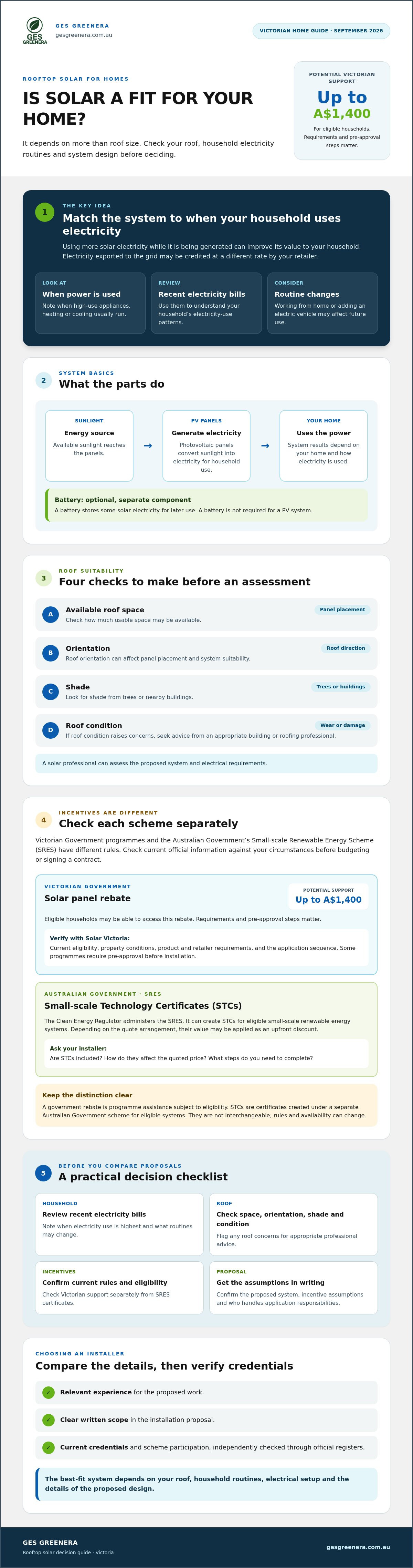
Before installing rooftop solar: a practical checklist for Melbourne’s west
A little preparation makes it easier to compare rooftop solar proposals. Use this five-step checklist to organise your questions before discussing a system with an installer:
- Review your bills. Note your electricity use and when your household is usually home.
- Assess the roof. Record visible shading, available space, roof access and any obvious condition concerns.
- Check incentives. Confirm current eligibility and application steps directly with Solar Victoria before including support in your budget.
- Compare proposals. Look beyond system size. Check the design, equipment and how the proposal suits your energy use and roof.
- Confirm installation details. Get the scope, exclusions, responsibilities and any electrical work in writing before proceeding.
What information should you prepare before requesting a solar assessment?
Gather recent electricity bills, household occupancy patterns and expected changes, such as working from home or adding an electric vehicle. Note roof access, shade at different times of day, and any existing solar panels or equipment. Ask whether the assessment considers your home’s electrical requirements and identifies work outside the quoted scope. If you already have a system, see this solar system upgrade guidance.
How can you compare solar proposals without focusing only on size?
Check how each proposed design responds to your bills, roof conditions and household routines. Ask for equipment details and a written installation scope, including exclusions, relevant warranties and assumptions behind estimated generation or savings. Treat estimates as projections, not guaranteed outcomes. Clear answers help you understand what’s included and compare proposals on a like-for-like basis.
Homeowners in Melton, Sunbury, Bacchus Marsh and nearby areas can ask about a site-specific assessment and check service availability for their address. Discuss a residential solar PV installation with GES Greenera.
Choosing a local rooftop solar installer and taking the next step
A good rooftop solar proposal should explain how the system fits your property, not just give a panel count. Compare providers on relevant residential solar experience, a clear written scope, current credentials and how directly they answer your questions. Independently check licensing, accreditation and any claimed scheme participation against the relevant current official registers. Don’t rely on a logo or verbal assurance alone.
What questions should you ask a rooftop solar installer?
Ask who will assess the roof, design the system and carry out the electrical installation. Before accepting a proposal, request written details covering:
- Proposed panels, inverter and system design.
- Installation work included, exclusions, approvals and who is responsible for each step.
- Applicable warranties and what after-installation support is available.
- How generation estimates were prepared, including the assumptions behind them.
Estimated generation or savings are projections, not guaranteed outcomes. Clear written answers make it easier to compare proposals and understand what you’re agreeing to.
How can a local electrical assessment help?
A site-specific assessment can consider your household’s electrical requirements alongside the proposed installation, helping identify relevant details before work is scheduled. GES Greenera provides residential solar PV system installation. Its listed Melbourne-area locations include Melton, Melbourne Airport, Diggers Rest, Deanside, Bacchus Marsh, Sunbury, Sunshine, Altona, Williamstown, Essendon, Thomastown, Epping, Eynesbury and Werribee. Confirm current coverage and installation availability for your address.
A practical next step is to ask about a home-specific assessment and discuss your questions before deciding. Discuss a rooftop solar assessment with GES Greenera.
Make your next solar decision with confidence
A suitable rooftop solar system is designed around the household, not just the roof. Review when you use electricity, check roof suitability and ask for a proposal that explains the design, equipment and installation scope. Before budgeting, confirm current Victorian programme conditions and Australian certificate arrangements through official sources. Then compare written quotes and verify installer credentials independently.
You don’t need to settle every detail before seeking advice. A home-specific assessment can help clarify electrical requirements and identify questions to resolve before you commit. GES Greenera provides residential solar PV installation and residential electrical services, making it a starting point for discussing your home’s needs.
Discuss a rooftop solar assessment with GES Greenera and ask whether installation is available in your area.
Frequently Asked Questions
Are rooftop solar panels worth it for a home in Victoria?
Rooftop solar for homes may be worthwhile if the system suits your roof and household energy use. Panels can provide electricity during daylight, potentially reducing the amount you buy from the grid, but savings aren’t guaranteed. Check your bills, note when you use the most power and compare that pattern with a home-specific system proposal before deciding.
What rebates are available for rooftop solar in Victoria in 2026?
As of September 2026, eligible Victorian owner-occupiers and rental properties may qualify for a Solar Victoria panel rebate of up to A$1,400. Conditions include household taxable income under A$150,000, property value under A$3 million, and no previous solar panel or battery rebate or solar system installed in the last 10 years. Use an approved retailer and get pre-approval before installation. Confirm current rules with Solar Victoria.
Can my home have rooftop solar if the roof is shaded?
Possibly, but the amount and timing of shade can affect panel placement and system performance. Trees, chimneys and nearby buildings may cast shade at different times of day, so note what you observe and ask for a site-specific assessment. An installer can consider roof orientation, usable space and shading when proposing a design. Significant shading may limit how suitable the roof is for solar.
How do I choose a rooftop solar installer in Melbourne’s west?
Compare providers on residential solar experience, clear written scopes and direct answers about equipment, exclusions and installation responsibilities. Independently verify the installer’s electrical licence and current accreditation through official registers, and check any claimed scheme participation. GES Greenera lists service locations including Melton, Melbourne Airport, Diggers Rest, Deanside, Bacchus Marsh, Sunbury, Sunshine, Altona, Williamstown, Essendon, Thomastown, Epping, Eynesbury and Werribee. Confirm current coverage for your address.
Do I need a solar battery with rooftop solar?
No. Solar panels convert sunlight into electricity, while a battery stores electricity for later use. You can install rooftop solar without a battery and use generated power as it’s produced. Whether storage suits your household depends on when you use electricity, your system design and your preferences. Ask for the costs, assumptions and expected use of any proposed battery to be explained separately in writing.


