

The tank size isn’t the only decision that shapes a successful heat pump installation. For a family, consider a heat pump hot-water system with storage capacity of 250 litres or above, then account for household hot-water use, electrical requirements and the space available for the unit.
It’s also sensible to look beyond the equipment itself: site conditions, existing pipework and electrical changes can affect the work involved. Eligible Victorian households may receive a A$1,000 Solar Victoria hot-water rebate, provided their existing hot-water system is at least three years old.
This guide explains what to consider before heat pump installation, including system size, electrical requirements and site conditions that may add work. It also covers incentives and practical planning points to help you prepare for an upgrade.
Key Takeaways
- Match system capacity to your household’s hot-water use and consider whether the available space suits the unit type.
- Check how the heat pump’s electrical connection and operating schedule may interact with your existing setup and electricity tariff.
- In NSW, residential and small business Energy Savings Scheme incentives apply to one-for-one water-heater replacements, with warranty requirements for eligible systems.
- Review the installation site, existing socket and pipework, and access around the tank, as these conditions can affect the work required.
What size heat pump do I need?
Start with your household’s hot-water use, not just the number of people. A family should consider a heat pump hot-water system with storage capacity of 250 litres or above to help meet demand. Think about when hot water is used, including showers, laundry and overlapping morning routines. A tank that’s too small may struggle during busy periods; a larger tank needs more room and may heat water that the household doesn’t use.
Australian homes commonly use all-in-one heat pumps, where the heat-pump unit and storage tank are combined, or split systems, where they are separate. Compare available space, pipe routes and household hot-water use when deciding which type may suit your home.
Plan a stable, open location with adequate airflow around the unit, and consider how its operating sound may affect nearby living or sleeping areas. In regions where temperatures fall to or below 0°C, water services must be protected from freezing under AS/NZS 3500.4:2021, Clause 4.11.1. External pipes and fittings should be buried at least 300 mm or covered with waterproof insulation if burial isn’t practical. Pipes in unheated roof spaces should sit at least 100 mm from the roof and external walls.
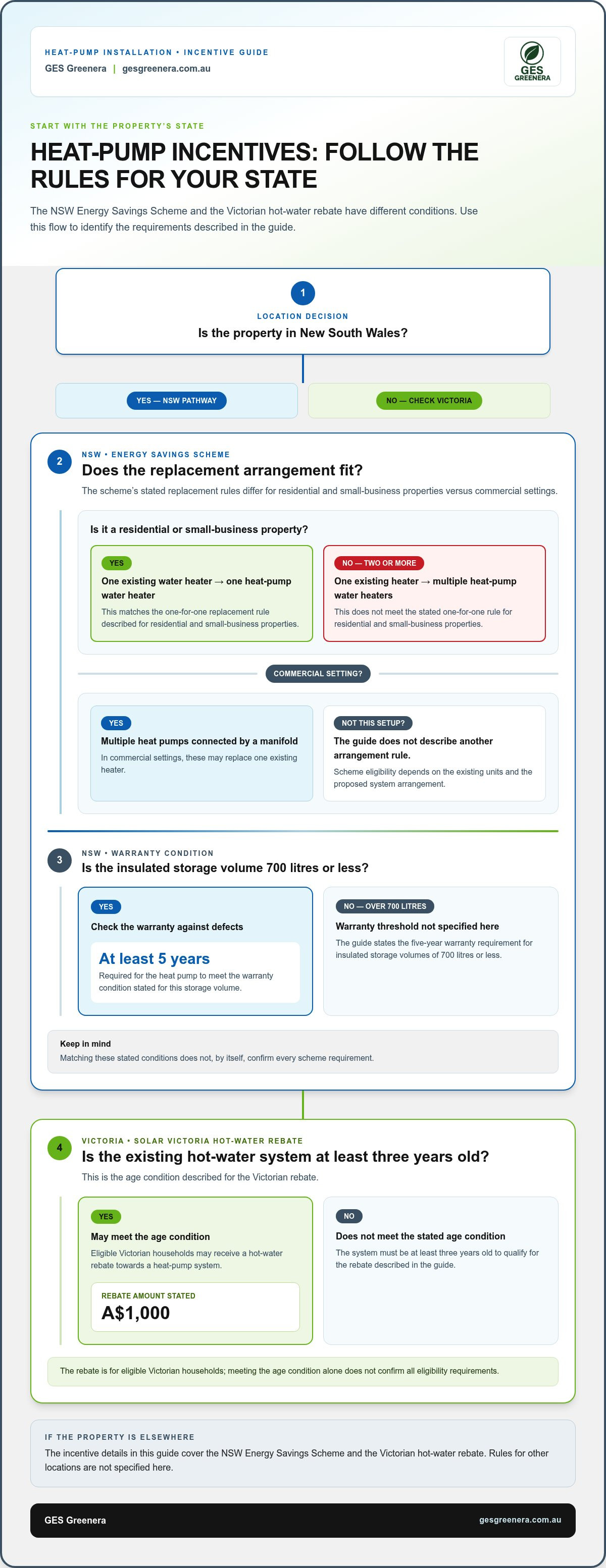
Eligible Victorian households may receive a A$1,000 Solar Victoria hot-water rebate towards a heat pump system. The existing hot-water system must be at least three years old to qualify for the rebate described.
Installing a heat-pump hot-water system involves assessing hot-water demand, selecting a suitable capacity and system type, and planning the location and connections. The tank and unit are then positioned, water and electrical services connected, and the system commissioned by qualified professionals.
What are the common problems, noise concerns and maintenance requirements for heat pumps? Performance can vary slightly in very low temperatures, and fan or compressor sound makes placement worth considering. Annual servicing by a qualified plumber can include filter cleaning, limescale removal, tank draining and flushing, and checking piping and valves.
Dedicated electrical circuits and isolators
Before choosing a connection, identify the heat pump’s electrical requirements and compare them with the home’s existing supply. Electrical connection requirements can vary between heat pump models, so check the unit’s specifications before installation. An electrician can assess the switchboard, circuit capacity, cable route and isolator position. This helps show whether the existing setup suits the unit or needs electrical work. Keep access to the isolator clear for safe servicing and make sure its location suits the equipment and surrounding space.
For Australian hot-water systems, AS/NZS 3500.4 requires hot-water pipework, valves and fittings to be insulated. Electrical connections and water plumbing are distinct parts of the job, so plan both around the unit’s position. Use a licensed electrician for electrical work, including circuit changes and isolator connections.
Operating times can affect electricity bills. A heat pump may run outside off-peak tariff periods, potentially increasing costs if it draws power at a higher rate. Compare the unit’s schedule with your electricity plan before setting its controls. With a time-of-use tariff, an overnight boost can be scheduled during the typically cheaper 1am-5am period. Ask your installer and energy retailer about how operating times align with your tariff.
Solar can help a home use more of its own electricity. Scheduling water heating during daylight hours lets the system use available solar generation. For a solar-powered home, a suggested schedule is to start at around 11 am, so the water is hot by 3 pm. Solar PV system design and heat-pump controls should work together, with the unit’s operating schedule matched to household demand.
Plan the heat pump installation around the unit’s electrical connection, isolator access, water plumbing and tariff. If you’re considering a solar system alongside hot-water upgrades, solar PV system installation can form part of that planning.
Energy Savings Scheme installation incentives
In NSW, the Energy Savings Scheme can support eligible heat-pump water-heater upgrades. For residential and small-business properties, the replacement must be one-for-one: one existing water heater cannot be replaced by two or more heat-pump water heaters. In commercial settings, multiple heat pumps connected by a manifold may replace one existing heater. Eligibility therefore depends on the number of existing units and the proposed system arrangement.
Warranty terms also matter. Under the NSW scheme, a heat pump with an insulated storage volume of 700 litres or less needs a minimum five-year warranty against defects to qualify for incentives. Compare the proposed system’s storage volume and warranty documents before proceeding. This helps identify whether the chosen water heat pump meets the scheme’s stated conditions.
Heat pumps transfer heat rather than generating it all directly with an electric element, so they use less electricity than conventional electric water heaters and produce fewer carbon emissions. Typical heat-pump efficiency is stated as two to four times that of a standard electric water heater. Actual running costs depend on electricity tariffs, household usage and operating schedules.
How do heat pumps compare with gas and electric hot-water systems in cost and efficiency? Compared with standard electric water heaters, heat pumps can deliver the same hot water using less electricity. Replacing an older gas storage heater in a household of three or more people is estimated to save up to A$500 per year, though the result depends on household use and energy costs.
To assess an incentive, identify the relevant state scheme and confirm its eligibility rules for the proposed replacement. For eligible NSW households, the one-for-one rule excludes replacing a single heater with multiple heat pumps. Victorian rebates have different requirements, so Melbourne households should assess eligibility under the Victorian scheme. Incentives may reduce upfront costs, while efficiency and energy source affect ongoing energy use and emissions.
Standard installation conditions and extra costs
The quoted scope depends on the site, not just the replacement unit. Start by checking the existing hot-water connections, electrical supply, switchboard location and access route. For an all-in-one system, a compatible existing 10A socket may avoid additional circuit work. The distance from that socket to the switchboard can affect the electrical work required. If the existing supply needs changes, those changes add work beyond positioning and connecting the heat pump.
Tank placement also affects the job. A split system needs at least 1.5 m of clear space above the tank so its anode can be removed. Check that the location leaves room for maintenance and doesn’t obstruct access to surrounding equipment. A support platform near ground level must maintain at least 100 mm clearance from surrounding ground under AS/NZS 3500.4:2021. The selected base and installation position can therefore influence preparation.
Water connections and pipe insulation form another part of the scope. Under AS/NZS 3500.4:2021, storage water heater inlet and outlet pipes, including valves, must be thermally insulated for at least the first 500 mm, subject to the stated heat-trap alternative. Existing pipe routes, valves and the condition of connections affect the work needed when replacing a hot-water system. Discuss these site details alongside government incentives, since eligibility and installation requirements are separate considerations.
In practical terms, extra work may arise from a distant switchboard, changes to electrical supply, difficult access, pipe alterations or a platform that needs preparation. The price depends on the case and is provided after a quote request; these site and connection factors shape the scope. A clear assessment helps distinguish standard connection work from additional tasks before the installation is planned.
For a site-specific assessment of your heat pump installation, request a heat pump installation quote.
GES Greenera: Residential Electrical Repairs
GES Greenera can help with residential electrical repairs when an existing electrical fault or supply issue needs attention before a heat pump installation. Resolving that fault helps clarify the electrical requirements for the new system. GES Greenera also provides heat pump installation, connecting the home’s electrical work with its hot-water upgrade.
If you are also considering renewable generation or vehicle charging, Solar PV System Installation and EV Charging Station Installation may be relevant projects. Planning them alongside heat pump installation can help coordinate electricity needs and equipment placement.
Contact GES Greenera to discuss your home’s electrical needs and heat pump installation plans.
Plan your next home energy upgrade
Consider how your household’s energy needs may change. Renovations, solar generation or vehicle charging can affect equipment placement and electricity use. Planning these projects together can help you decide what to address first and avoid clashes between future upgrades.
Before arranging heat pump installation, note your priorities, including servicing access, hot-water reliability and compatibility with other electrical work. These details help shape an installation plan for your home. GES Greenera also provides Residential Electrical Repairs, Commercial Switchboard Upgrades and Solar PV System Installation.
To discuss your heat pump installation and identify a suitable next step, contact GES Greenera about installation. A clear plan can help you move forward with confidence.
Frequently Asked Questions
How do Heat Pumps work?
A heat pump draws warmth from the surrounding air and uses a refrigerant cycle to raise its temperature. A compressor increases the refrigerant’s temperature, then a heat exchanger transfers that heat to water in the storage tank. The system uses electricity to move heat rather than producing all the heat directly. Performance can change with outdoor conditions, so placement and operating settings matter.
How long is turnaround?
Turnaround depends on the installation scope and site readiness. A straightforward replacement with accessible water and electrical connections involves fewer tasks than work requiring switchboard changes, pipe rerouting or platform preparation. The timing of a heat pump installation also depends on coordinating the required work and having the selected equipment ready. A site assessment helps establish the sequence and identify tasks that could affect timing.
What areas do you service?
GES Greenera services Melbourne and surrounding areas, including Melton, Melbourne Airport, Diggers Rest, Deanside and Bacchus Marsh. Its service area also includes Sunbury, Sunshine, Altona, Williamstown, Essendon, Thomastown, Epping, Eynesbury and Werribee. These locations cover homes across Melbourne’s west and nearby districts. The business is based in Altona, Victoria, and provides residential electrical and energy services across its local service area.
What brands do you install?
GES Greenera installs heat-pump hot-water systems. When comparing options, consider storage capacity, operating conditions, maintenance requirements and the manufacturer’s warranty. Check that the unit’s dimensions and connections suit your home. Brand names alone do not show whether a model matches your household’s hot-water use or installation site, so compare the manufacturer’s specifications with these practical requirements.
What rebates am I eligible for?
Eligible Victorian households may receive a A$1,000 Solar Victoria hot-water rebate towards a heat pump system if their existing hot-water system is at least three years old. In NSW, the Energy Savings Scheme has a one-for-one replacement rule for residential and small-business settings. Eligibility depends on location, replacement arrangement and system requirements, so the relevant state scheme determines which incentive may apply.
How much does a heat pump installation cost in Australia?
Heat pump installation costs depend on the system selected, site access, existing electrical supply, pipework and any preparation required. GES Greenera provides a free, no-obligation quotation based on the home and project scope. Request a quotation to get a figure that reflects the equipment, connections and site conditions.


