

A solar battery can reduce your reliance on the grid, but it won’t automatically make your home independent from it. Solar batteries in Melbourne store surplus power for later use, while a system designed for backup can supply selected household circuits during an outage. Staying connected can still make sense if your home uses more electricity than your panels and battery can provide.
It’s understandable to want more control over when you use grid electricity, especially as your household’s energy needs change throughout the day. The right decision depends on how much solar power you generate, when you use electricity and whether backup power matters to you.
This guide explains how batteries work with existing solar panels, what affects their suitability and how to assess grid reliance without assuming a battery is right for every home. You’ll also learn which practical details matter when planning a system for your Melbourne property.
Key Takeaways
- A solar battery can store daytime surplus for later use, but it doesn’t automatically let a grid-connected home disconnect from the electricity network.
- Before adding storage to existing panels, compare your solar generation with when your household uses power to see whether a battery could make practical sense.
- Shifting more electricity use to your own stored solar energy may help manage grid reliance; household patterns and system setup shape the potential benefit.
- Assess battery suitability by weighing your energy needs, desired backup capability and how the system would work with your existing solar setup.
Can I disconnect from the grid if I have a solar and battery system?
A home solar system with a battery usually remains connected to the electricity grid. The battery stores surplus power from your panels for later use, while grid electricity can cover demand when stored energy runs low. Going off-grid requires a system designed to meet your household’s needs without a backup connection.
Home batteries available in Melbourne commonly have capacities between 10 and 50 kWh. Lithium batteries can generally be discharged to about 80-90% of nominal capacity and usually have efficiency greater than 90%. Warranty terms vary; leading battery brands offer a 10-year warranty period with at least 70% capacity retention.
For a Victorian installation, solar installers must be accredited through Solar Accreditation Australia. Grid connection approval and electrical safety requirements also need to be addressed during planning. The connection process depends on the network and system, so include these steps in your installation plan.
Rebates may affect the upfront decision. Solar Victoria offers eligible owner-occupiers a rebate of up to A$1,400 through the Victorian Solar Homes Program. Eligibility matters, so include available rebates when comparing options rather than assuming every household qualifies.
A retailer can help plan a battery system, or a combined solar and battery system, to reduce energy bills. Compare your tariff with the value of using stored electricity later. Then consider whether cheaper grid power at certain times would change when you charge or use the battery.
Common reasons to install a home battery include using more of your own solar electricity after sunset, managing grid reliance and having backup during an outage. Backup depends on system design. Ask how the battery would serve your essential household circuits, and review the product warranty and customer support arrangements before deciding.
Installer experience matters when integrating panels, a battery and the grid. A clear installation plan should explain system compatibility, connection steps and support after handover. These details help you judge whether the setup fits your energy use, rather than choosing a battery based on capacity alone.
Is it worth adding a battery to existing solar panels?
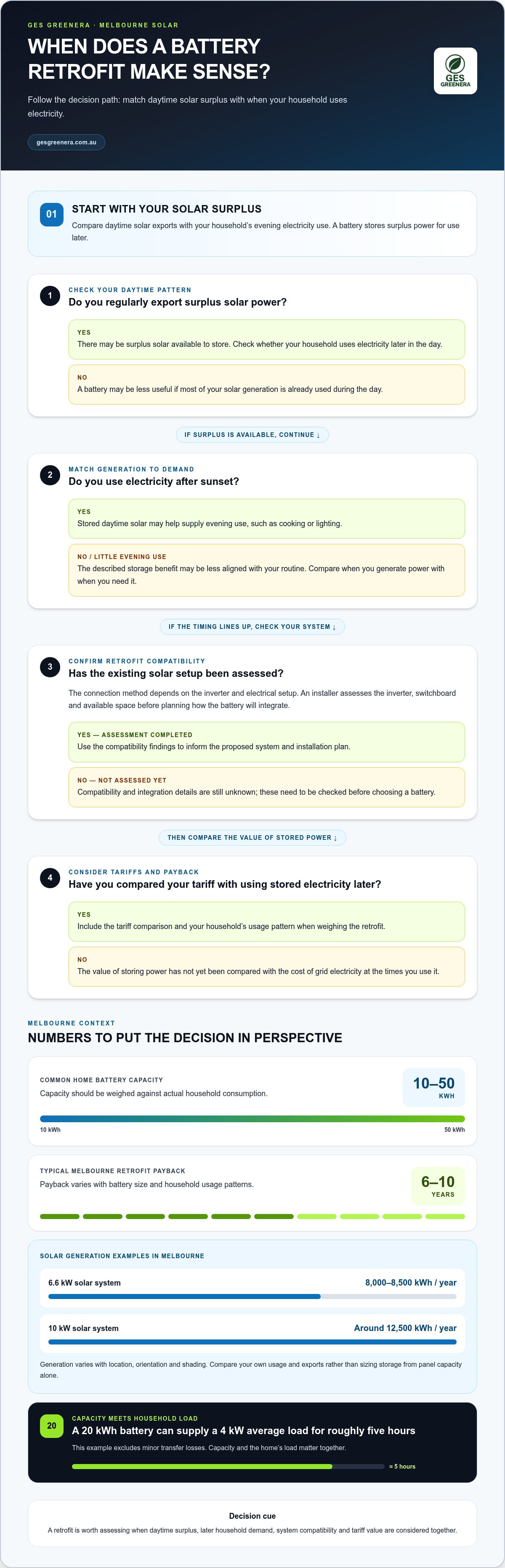
Adding storage can help a Melbourne household use more of its own solar electricity after sunset. Whether a retrofit is worthwhile depends on panel generation, household demand and the value of storing surplus power.
Retrofitting batteries to existing solar
A battery can be added to an existing solar system, but the connection method depends on its inverter and electrical setup. An installer assesses the current system, including the inverter, switchboard and available space, before planning the retrofit. This identifies what needs integrating and whether the battery can use surplus power from the solar panels.
Compare your daytime exports with evening electricity use. A retrofit may suit a home that regularly exports surplus power but draws electricity later; it may be less useful if most solar generation is already used during the day. Battery size and usage patterns affect payback, with a Melbourne retrofit typically taking 6 to 10 years.
Solar system size gives useful context, but generation varies with location, orientation and shading. A 6.6 kW system in Melbourne typically generates 8,000 to 8,500 kWh per year; a 10 kW system generates around 12,500 kWh. Compare your own usage and exports with generation before choosing a battery, rather than sizing storage from panel capacity alone.
Modular and scalable battery systems
Modular solar battery storage lets a system be built around current needs, with some designs allowing capacity to expand later. Ask how the modules work together and whether the planned setup matches your inverter and expected household demand. Lithium-ion chemistry and modular storage have made installations simpler, but the right configuration still depends on the home’s solar system.
Home batteries commonly store between 10 and 50 kWh. A smaller system may fit a household seeking to cover evening use, while a larger capacity may be relevant when demand is higher. Size storage against actual consumption, not a goal to maximise battery capacity.
Off-grid systems are different from battery retrofits that remain connected to the grid. They must be planned around household demand and the solar generation available to supply it, including periods when panels produce less. For a grid-connected home considering an off-grid change, solar system planning can help map generation, storage and energy use together.
Energy self-consumption and time-based control
Self-consumption means using solar power at home instead of exporting it. Battery storage can shift some daytime generation to evening use, when panels produce less.
Household self-consumption and time-based control
Compare when your solar system generates electricity with when your household needs it. For example, stored daytime solar can supply evening cooking or lighting, while your retailer’s tariff may affect the value of shifting use. Time-based controls can coordinate battery charging and household demand around these periods.
Compare the battery’s operating settings with your tariff and daily routine. A schedule that suits a household using power after sunset may not suit one with substantial daytime demand.
Household energy use and battery sizing
Size storage against actual consumption, not the largest battery available. A 20 kWh battery can supply a home averaging 4 kW for roughly five hours, excluding minor transfer losses. This example shows why capacity and the home’s load matter together.
Review how much power essential appliances draw and when they run. A 10 kWh battery may cover a different share of household needs than a larger system, depending on demand and usable capacity.
Assessing household energy needs
Start with electricity bills and smart meter records, then note when major appliances and other loads operate. Include seasonal changes and planned additions, such as an electric vehicle, because these can alter demand. A clear usage profile helps match storage to the energy your household can use.
Compare product warranties by their coverage period and stated capacity retention. Consider how incentives affect the decision, alongside expected use, battery performance and the value of stored solar power.
For commercial energy storage, load shifting means storing electricity when solar generation is available, then using it during periods of higher demand. A business can compare its operating schedule with its tariff to identify when shifting consumption may be useful.
Backup power can support selected household loads during an outage if the system is designed for backup. Decide which circuits matter most, such as refrigeration or lighting. This helps distinguish backup needs from a broader goal of energy independence.
Assessing whether a solar battery is suitable
A battery suits homes with a clear use for stored electricity, but solar and battery systems aren’t right for every household. Start by comparing solar exports with evening demand, then weigh the value of using stored power against system cost and expected performance.
Usable capacity depends partly on battery chemistry. Lithium batteries can generally be discharged to about 80-90% of nominal capacity, compared with about 50-60% for lead-acid batteries. Lithium batteries should usually have efficiency greater than 90%, so less stored energy is lost during charging and discharging.
Check the inverter and solar system before selecting a battery. The equipment must work together to manage solar generation, battery charging and household use. An assessment should also account for when the home uses electricity, how much surplus solar is available and whether backup power is a priority.
Warranty terms help homeowners compare expected performance over time. Leading battery brands offer at least 70% capacity retention over a 10-year warranty period. Lithium batteries usually retain about 60-80% of their original capacity at end of life. They should last 10 years or more under normal use when kept away from extreme temperatures.
Consider the outcome you want before you switch to a battery system. A home focused on using more solar after sunset has different requirements from one prioritising outage backup. In Australia, a 10 kWh lithium-ion battery is rated for 6,000 to 10,000 charge cycles, but daily use and system conditions shape how that rating applies in practice.
Use these checks to frame the decision: match usable capacity to evening demand, confirm the inverter can integrate the battery, and compare warranty coverage with your intended use. If those factors align, plan a solar and battery system around your household’s energy needs.
GES Greenera: Residential Electrical Repairs
GES Greenera provides residential electrical repairs and solar PV system installation for homeowners planning electrical work or reviewing their solar setup. If you’re considering a battery, an electrical assessment can clarify how your existing panels, inverter and switchboard fit into the wider system.
Turn to GES Greenera when a fault needs attention or you’re planning a solar upgrade alongside other electrical work. For businesses, commercial switchboard upgrades can address switchboard needs, while EV charging station installation can support a move to electric transport. The right work depends on the property and the project.
Share what you want your solar system to do, such as using more of your generated power at home or planning future electrical upgrades. Contact GES Greenera to discuss your electrical project.
Make your next energy decision with confidence
Before choosing a battery, turn your goals into a practical plan. Decide which household loads matter most, whether outage backup is important and how you want to use solar power. This gives an electrical assessment a clear purpose and keeps the discussion focused on your property, rather than a product’s headline capacity.
For solar batteries in Melbourne, GES Greenera can help with the electrical work that supports your plans. Services include solar PV system installation, residential electrical repairs and commercial switchboard upgrades. Discuss your current setup, intended energy use and future electrical changes together, so the next step reflects how you expect to use your home or premises.
Bring your priorities and questions to the conversation, then explore a suitable path forward. Contact GES Greenera about solar batteries and take the next step towards a system that fits your energy plans.
Frequently Asked Questions
How does battery storage work?
A battery stores electricity generated by solar panels so it can be used later. Surplus solar power charges the battery during generation, then an inverter converts the stored energy into electricity for household circuits. For example, a home can use stored solar after the panels stop generating. System controls determine how power is directed between household use, storage and the grid.
How much should a 10kWh battery cost?
The installed price depends on the battery model, inverter compatibility, switchboard requirements and installation work. A 10 kWh battery’s capacity alone doesn’t set its final price, because the existing solar system and electrical setup affect the scope. The price depends on the case and is provided after a quote request. Compare the proposed equipment and installation inclusions, rather than capacity alone.
Are home batteries a worthwhile investment?
A home battery may be worthwhile if the value of using stored solar electricity suits your household’s energy pattern and the system’s upfront cost. Review your electricity bills alongside solar generation and exports, then consider how much power you use after sunset. A household that already uses most solar power during the day may have less surplus to store than one that exports regularly.
Can I get the government solar battery rebate?
Eligibility depends on the program’s conditions and the system installed. The federal Cheaper Home Batteries Program applies to batteries with nominal capacity of 5-100 kWh, with the rebate applied to the first 50 kWh of usable capacity. Installation must be on or after 1 July 2025, with an accredited installer and an eligible battery. Solar Victoria offers eligible owner-occupiers a rebate of up to A$1,400.
What is the average cost of solar batteries in Melbourne, including installation?
There isn’t one price that applies to every Melbourne home. The installed price depends on battery capacity and model, inverter compatibility, switchboard work and whether the system is a retrofit or part of a new solar installation. The price depends on the project and is provided after a quote request. Compare the written scope, including equipment and installation, when assessing proposals.
What battery size is suitable for a typical Melbourne household?
There’s no single battery size that suits every Melbourne household. Use your electricity records to identify evening demand, solar exports and any essential circuits you want backed up. Then match usable battery capacity to the energy you can realistically store and use. A household with high evening consumption may need a different configuration from one that uses most electricity during daylight hours.


