

What makes a solar setup work for your Melbourne home depends on more than roof size. When considering solar energy for house use, look at when your household uses power, how much of that demand can be met during daylight hours, and whether the roof and electrical setup suit a system. Start with your household’s electricity use, then weigh it against the roof’s usable space, orientation and shade.
This guide explains how rooftop solar PV works and how your home can use, store or export the electricity it generates. It covers the practical details to assess, including household routines, batteries, grid connection and current incentives. If you live in Melbourne’s west or north-west, these steps can help you prepare for a solar installation suited to your property.
Key Takeaways
- Rooftop solar panels generate electricity, and an inverter converts it into a form your home can use.
- Check your roof, household electricity habits and electrical setup when assessing solar energy for house use.
- Shifting flexible electricity use to daylight hours may help your household use more of the solar power it generates.
- Before planning an installation, gather household usage information and arrange a site assessment with a local Melbourne solar installer.
Solar energy for your house: what it does and what it can change
Residential solar photovoltaic (PV) is a rooftop system that converts sunlight into electricity for household use. Solar panels generate electricity from sunlight, as outlined in How Solar Power Works. The practical value for your home depends on how much of that electricity you use, as well as system design, your electricity tariff and conditions at the property.
Using solar power at home may reduce the amount of electricity you buy from the grid and increase your use of renewable energy. It does not guarantee a particular bill reduction or payback period. Results vary according to generation and household consumption.
What can household solar power run?
While the system is generating electricity, it can supply household loads such as appliances, lighting and electronics. If generation exceeds what the home is using at that moment, surplus electricity may be exported to the grid. Using solar directly and exporting surplus are different outcomes. The value of exported electricity depends on your retailer’s feed-in tariff. Panels alone do not provide power after dark or guarantee supply during a grid outage.
When might rooftop solar suit a Melbourne home?
Start with the roof: its condition, usable space, orientation and shading all matter. Trees, neighbouring buildings and other obstructions can cast shade, while the roof’s direction and layout affect system planning. A site assessment brings these factors together with your household’s electricity use.
Conditions vary from home to home across Melbourne’s west and north-west. A roof in Melton may have different shade or usable space from one in Sunshine, Sunbury or Werribee. The 2026 Melbourne Home Solar Guide provides broader local context, while an assessment at your property can help shape a plan for solar energy for house use.
How a home solar PV system turns sunlight into usable electricity
Solar panels generate direct current (DC) electricity when sunlight reaches their cells. Household wiring and most everyday appliances use alternating current (AC), so an inverter converts the electricity into a usable form. The inverter converts solar-generated DC electricity into AC electricity for household use, as explained in the U.S. Department of Energy’s overview of Solar Energy Technologies.
The electricity then supplies the home’s active needs. If the panels are not generating enough for household demand, such as on a cloudy day or in the evening, grid electricity can make up the shortfall. Solar works alongside your home’s wider electrical setup rather than replacing the grid connection.
What do the panels and inverter each do?
Panels capture sunlight and produce DC electricity. The inverter changes it to AC so household circuits can use it. Both components have distinct roles in a home solar PV system: panels generate the electricity, while the inverter manages the conversion between rooftop generation and the power your home can use.
Where does unused solar electricity go?
During the day, household demand uses available solar generation. If the system produces more electricity than the home needs at that time, the surplus may be exported to the grid. A retailer may credit exported electricity through a feed-in tariff, but the rate depends on your electricity plan. Do not treat export credits as a guaranteed return.
If you are considering storing surplus electricity for later, battery storage is a separate part of system planning. A battery can change when you use solar-generated electricity, but it does not alter the basic flow from panels through the inverter. A site assessment can help match the system design to your home’s electrical setup. GES Greenera installs residential solar PV systems across Melbourne’s west and north-west. Learn more about residential solar installation.
How to assess solar energy for your house in Victoria
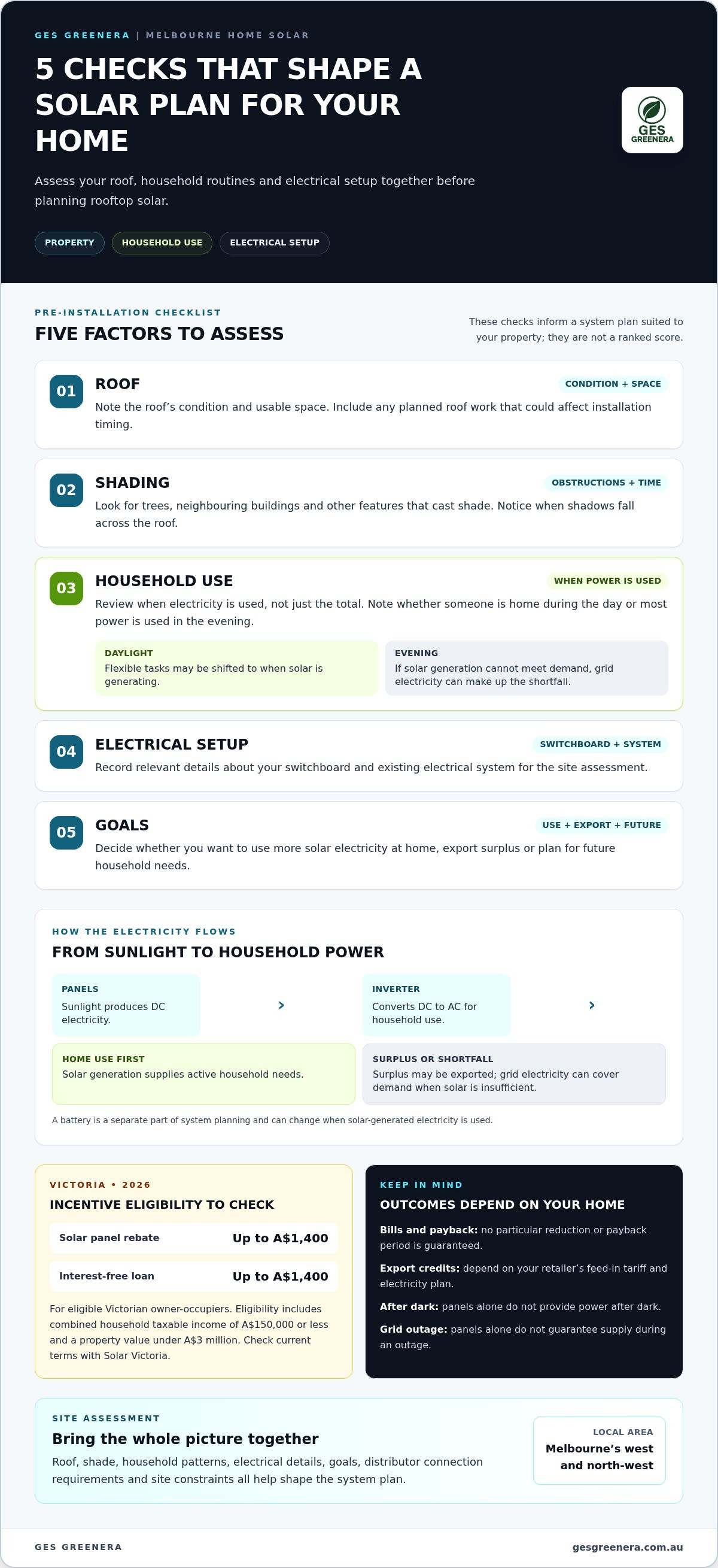
To assess whether solar energy for house use suits your home, consider the roof, household routines and electrical setup together. Work through these five points before planning a system:
- Roof: Note its condition, usable space and any planned roof work that could affect installation timing.
- Shading: Identify trees, neighbouring buildings and other features that cast shade. Note when shadows fall across the roof.
- Household use: Review when electricity is used, not just the total. Note whether someone is home during the day or most power is used in the evening.
- Electrical setup: Record relevant details about your switchboard and existing electrical system for the site assessment.
- Goals: Decide whether you want to use more solar electricity at home, export surplus or plan for future household needs.
Which roof and household details matter?
If nobody is usually home during daylight hours, consider whether flexible tasks, such as running a dishwasher or washing machine, could be shifted to the day. This may help you use more electricity as it is generated. An on-site assessment brings the roof, shade, household patterns and electrical details together to inform a solar energy for house plan suited to the property.
What should Victorian households check before proceeding?
In 2026, eligible Victorian owner-occupiers may qualify for a Solar Homes Program solar panel rebate of up to A$1,400 and an interest-free loan of up to A$1,400. Eligibility includes a combined household taxable income cap of A$150,000 and a property value under A$3 million. Review current eligibility and application guidance directly with Solar Victoria, as terms can change. The Rooftop Solar for Homes: Rebates and Benefits in Victoria article offers further context.
Distributor connection requirements and site constraints can also affect planning. Roof condition, usable space, shade, electricity-use patterns, electrical setup, goals and applicable Victorian requirements all help shape a suitable system. GES Greenera installs solar PV systems across Melbourne’s west and north-west. Explore GES Greenera’s solar installation service.
Plan a safe home solar installation with a local Melbourne electrician
A safe installation starts with information about your home, not a one-size-fits-all system. Gather a recent electricity bill or usage data and note when your household typically uses power. This gives the planning process a clearer picture of your needs before the roof and electrical setup are assessed.
What happens during solar system planning and installation?
Planning brings together the roof’s usable space and shading, your household’s electricity use, and the condition of the existing electrical system. The switchboard is part of that wider setup, so relevant electrical work can be considered as the solar installation is planned.
In Australia, solar PV work must be carried out by a licensed electrician with Solar Accreditation Australia (SAA) accreditation. Installations must comply with applicable requirements, including AS/NZS 3000, AS/NZS 5033 and AS/NZS 4777. Grid-connected systems also require approval from the local distribution network service provider before installation. These steps help ensure the system is planned for the property and its connection to the electricity network.
The process is straightforward: share your usage information, arrange a site assessment, review a design suited to your home, then proceed with professional installation and the required connection steps. System size, output and bill impacts depend on the specific project, so do not assume them in advance.
Where can local households get started?
GES Greenera installs residential solar PV systems for households across Melbourne’s west and north-west, including Melton, Melbourne Airport, Diggers Rest, Deanside, Bacchus Marsh, Sunbury, Sunshine, Altona, Williamstown, Essendon, Thomastown, Epping, Eynesbury and Werribee. After installation, good care helps you keep an eye on system performance; the Solar Panel Maintenance Melbourne article is a useful companion for understanding ongoing upkeep.
Start with your electricity-use information and a site assessment, then let the roof, household requirements and electrical setup guide the plan. Explore GES Greenera’s solar installation service and take the next step towards a professionally planned system for your home.
Make your next solar decision with confidence
Turn your interest in solar energy for house use into a plan shaped around your household. Gather a recent electricity bill and note when your home is usually occupied. Consider whether you expect your energy needs to change, for example if you plan to add an electric vehicle or heat pump. These details can make a site assessment more relevant to your plans.
GES Greenera installs residential solar PV systems for households across Melbourne’s west and north-west, including Melton, Sunbury and Werribee. A tailored plan gives you a clearer basis for deciding how solar could fit your home and future energy use, without relying on assumptions about another household’s setup.
Explore GES Greenera’s residential solar installation service and take a practical next step towards a system planned for your home. With the right information in hand, you can move forward feeling more prepared.
Frequently Asked Questions
Is solar energy for a house worth considering if nobody is home during the day?
Yes, it may still be worth considering, especially if some electricity use can be shifted to daylight hours. For example, you might run a dishwasher or washing machine before evening, where practical and in line with the appliance instructions. If daytime use is consistently low, compare likely self-use and export with your retailer’s feed-in tariff when weighing up the system.
Can rooftop solar power a house during a blackout?
Usually, a standard grid-connected solar system shuts down during a blackout for safety, so it will not necessarily keep your home powered while the network is off. Backup supply generally requires a compatible setup, which may include a battery and equipment that can isolate selected circuits from the grid. Do not assume solar panels alone will run household appliances during an outage.
How much electricity can solar panels generate for a house?
There is no single output figure that applies to every home. Generation depends on the system design and site conditions, as well as changes in sunlight across seasons and weather. For a home in Melbourne’s west or north-west, use a site-specific estimate rather than a broad daily average. Compare expected generation across the year with your household’s electricity use.
Do solar panels power a house at night?
No, solar panels generate electricity from sunlight, so they do not produce solar power after dark. At night, a home typically draws electricity from the grid unless it has a battery with stored energy available for use. How much a battery can supply depends on the system and household demand, so consider which evening loads matter most when planning storage.
Can I install solar panels if my roof is shaded or needs repairs?
Possibly, but the amount and timing of shade can affect how a system is planned and how much electricity it generates. Note whether shadows fall in the morning, afternoon or across different seasons. If the roof needs repairs, have its condition addressed before installation planning proceeds. A site assessment can help determine whether the roof is suitable for panels.


