

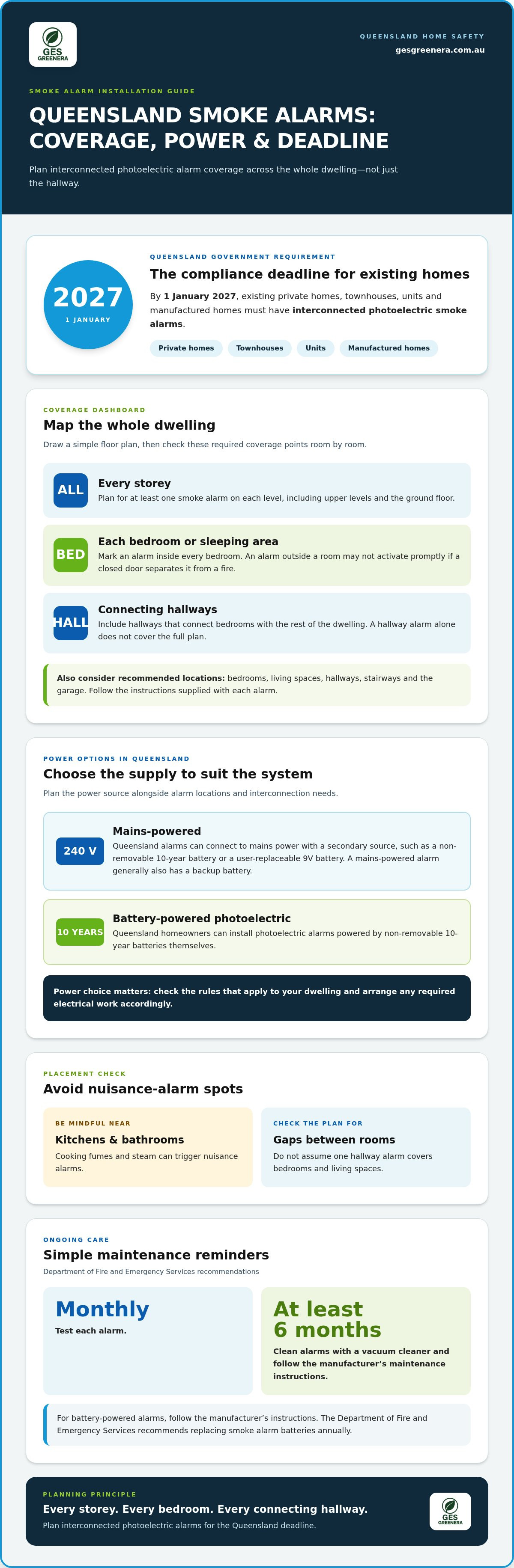
A hallway alarm alone won’t meet Queensland’s full smoke alarm requirements. According to Queensland Government, by 1 January 2027, existing private homes, townhouses, units and manufactured homes must have interconnected photoelectric smoke alarms. To install smoke alarms in these homes, plan for coverage on every storey, in each bedroom or sleeping area, and in hallways connecting bedrooms with the rest of the dwelling.
Choosing alarm locations and power options may seem like a small detail, but both affect how well the system suits your home. This guide explains where alarms belong, how hardwired and battery-powered options differ, and what Queensland’s compliance rules mean when you’re upgrading.
Use these steps to plan the installation, understand when electrical work is involved and keep the requirements in view. You’ll also learn what to consider in new and existing homes, so you can make a practical, safety-focused decision.
Key Takeaways
- Map alarm coverage across every storey, bedroom or sleeping area, and hallway connecting bedrooms with the rest of the dwelling.
- Choose locations that support early warning throughout the home, while avoiding spots where everyday cooking or showering may trigger nuisance alarms.
- Compare mains-powered and battery-powered options, and plan the power source alongside the alarm locations and interconnection needs.
- Prepare for the deadline: according to Queensland Government, existing private homes, townhouses, units and manufactured homes must have interconnected photoelectric smoke alarms by 1 January 2027.
How can I upgrade or install smoke alarms?
Start by mapping the dwelling and its sleeping areas, then plan alarm coverage and ongoing care. Queensland’s regulations set requirements for different types of residential properties.
-
Plan smoke alarm coverage per level
Draw a simple floor plan and mark every storey, including upper levels and the ground floor. Queensland’s requirements cover private homes, townhouses, units and manufactured homes. Plan for at least one alarm on each storey, then mark bedrooms and connecting hallways to map the full coverage. Shared accommodation and other commercial premises where people sleep are covered separately in a Department of Planning Building Regulation Advisory Note.
-
Include coverage in bedrooms
Mark each bedroom or sleeping area and plan an alarm inside each one. A bedroom alarm can alert occupants to a fire in that room. An alarm outside the bedroom may not activate promptly if a closed door separates it from a fire. In Queensland, include the hallway connecting the bedrooms with the rest of the dwelling. Check the plan room by room instead of assuming a hallway alarm covers a bedroom.
-
Plan testing, cleaning and replacement
Set a monthly reminder to test each alarm, following the Department of Fire and Emergency Services recommendation. Clean alarms with a vacuum cleaner at least every six months, as the department recommends, and follow the manufacturer’s instructions for maintenance. For covered residential properties in Perth, WA, alarms must be no more than 10 years old. Check each unit’s age and arrange replacement when it reaches that limit.
-
Estimate purchase and installation costs
List how many alarms you need and whether the work involves new wiring or replacing existing units. Purchase and installation costs depend on those details, the alarm type and the work required. The price depends on the case and is given after a quote request; the number of units, power option, wiring access and installation complexity affect the cost.
Smoke alarm installation locations
Map each room before choosing alarm positions, then check the ceiling and note nearby sources of steam or cooking fumes. Fire and Rescue NSW recommends coverage across bedrooms, living spaces and key routes through the home.
-
Choose recommended alarm locations
Mark bedrooms, living spaces, hallways, stairways and the garage on your floor plan. Fire and Rescue NSW recommends smoke alarms in these areas, not just beside the main bedroom. A suitable position is on the ceiling between sleeping and living areas, helping cover the route between them.
When you install smoke alarms, follow the manufacturer’s instructions for each unit. Check that your plan includes every bedroom and living area, as well as hallways and stairways. For a registered Queensland caravan or motorhome, Queensland Fire Department recommends at least one working photoelectric smoke alarm on the ceiling.
-
Check placement for common mistakes and safety risks
Review the floor plan for gaps, then avoid placing alarms in or near kitchens and bathrooms. Cooking fumes or steam can trigger nuisance alarms, making a poor location disruptive. Don’t rely on one hallway alarm to cover every room when recommended locations include bedrooms and living spaces.
Check the manufacturer’s instructions before fixing each alarm in place. A fire in a bedroom with its door closed may not activate an alarm outside the room until the fire burns through the door. A working alarm inside the bedroom can provide an alert there. Smoke toxins can impair breathing and vision, making clear thinking and escape harder.
Finally, check the route between bedrooms and the rest of the dwelling. In Queensland homes, connecting hallways are part of the required coverage. Before completing the plan, check each marked position against the room’s use, ceiling location and nearby cooking or bathroom activity.
Hardwired and battery-powered alarm options
Choose the power source alongside the alarm’s location and interconnection needs. The right option depends on the dwelling and the rules that apply in your state.
- Check whether mains power is required before choosing an alarm. In Queensland, smoke alarms can connect to 240v mains power, with a secondary source such as a non-removable 10-year battery or a user-replaceable 9V battery. A mains-powered alarm generally also has a backup battery. Match the alarm’s power arrangement to the system planned for the home.
- Use battery-powered alarms where the rules allow them. Queensland homeowners can install photoelectric alarms powered by non-removable 10-year batteries themselves. In WA, battery alarms must have a non-removable 10-year-life battery, and are permitted where consumer mains power isn’t connected or there’s no hidden space for wiring. In other WA circumstances, local government approval is required for battery power instead of mains power.
- Arrange a licensed electrician for mains-connected work where required. In NSW, hardwired smoke alarms must be installed by a licensed electrician. In WA, a licensed electrician must connect or disconnect an alarm that requires permanent mains power. These rules apply when replacing a unit or changing its power supply, not just when installing an alarm on a new ceiling.
- Plan battery maintenance as part of your choice. The Department of Fire and Emergency Services recommends replacing smoke alarm batteries annually; follow the manufacturer’s instructions for the alarm. A non-removable 10-year battery reduces routine battery changes, while a user-replaceable battery needs periodic attention. Keep the model’s power details and instructions accessible for future testing or replacement.
Queensland smoke alarm compliance requirements
Use Queensland’s requirements to assess your property, then check the rules that apply to its location and use. Queensland’s deadline applies to existing homes as well as new dwellings.
- Compare your home with the Queensland deadline. According to Queensland Government, existing private homes, townhouses, units and manufactured homes must have interconnected photoelectric smoke alarms by 1 January 2027. Queensland rules also require alarms on each storey, in every bedroom or sleeping area, and in hallways connecting bedrooms with the rest of the dwelling. Use these categories to check your floor plan and identify any upgrade work.
-
Clarify rental installation and maintenance responsibilities
For a Queensland rental, separate the landlord’s pre-tenancy duties from the renter’s ongoing tasks. The landlord must test and clean each alarm within 30 days before a tenancy starts. During the tenancy, the renter must test and clean each alarm at least once every 12 months. Record these checks and address any alarm that fails its test.
-
Check AS 3786 compliance
Check the alarm’s compliance information against AS3786-2014. Queensland smoke alarms must comply with this Australian Standard; Queensland legislation introduced on 1 January 2017 requires compliance. When planning an upgrade, check the standard as well as alarm type, location and interconnection. A compliant alarm still needs to meet the placement and connection requirements applying to the dwelling.
- For Australia-wide comparisons, treat each state and territory’s requirements separately. NSW’s minimum is one alarm per dwelling level. In covered Perth residential properties, WA requires mains-powered alarms, with battery alternatives permitted in specified circumstances. Queensland’s broader interconnected photoelectric requirement has a 1 January 2027 deadline; don’t assume one jurisdiction’s rule applies across Australia.
For Queensland sellers, a dwelling must be upgraded before transfer if the sale contract is signed after 31/12/2021. Plan the work around the transaction, and use smoke alarm testing to help assess alarm operation.
GES Greenera: Residential Electrical Repairs
GES Greenera provides residential electrical repairs when electrical issues need attention alongside smoke alarm upgrades. If you’re planning alarm work and have concerns about existing electrical faults, GES Greenera can help address those faults as part of your home’s electrical needs.
For broader projects, GES Greenera also provides commercial switchboard upgrades, solar PV system installation and EV charging station installation. These services address separate electrical and energy needs, while residential repairs are relevant when faults affect your home.
For smoke alarm testing, follow the maintenance schedule and manufacturer’s instructions covered above. If you need help with a residential electrical repair, contact GES Greenera or visit gesgreenera.com.au.
Plan for changes to your home
Treat smoke alarm planning as part of future home changes, not a one-off task. Before you install smoke alarms, renovate, convert a room or change how bedrooms are used, consider whether the planned layout still suits the spaces people occupy. Think this through before building work begins, while ceiling access and wiring decisions can be coordinated.
Keep a simple home safety record with the current floor plan, alarm model details and dates of changes. Share relevant updates with household members so they know what has changed and where equipment information is kept. For a rental, make the handover clear when occupants change. Current records can help coordinate later maintenance and electrical work.
If electrical work is part of your home upgrade, contact GES Greenera to discuss your needs. Get in touch with GES Greenera and take the next step with a clear plan.
Frequently Asked Questions
Are battery powered smoke alarms permitted?
Yes, battery-powered alarms are permitted in some circumstances, but the rules vary by state. In Queensland, homeowners can install photoelectric alarms with non-removable 10-year batteries. In WA, battery alarms need a non-removable 10-year-life battery and are allowed in specified situations, such as where mains power isn’t connected. Check the applicable state requirements before choosing an alarm for your property.
Are there penalties involved?
Penalty rules depend on the state or territory and the type of non-compliance, so there is no single penalty amount for all of Australia. A landlord’s responsibilities may differ from a renter’s, and sale or tenancy requirements can also apply. First identify the property’s jurisdiction and situation, such as whether it is an existing home, rental or sale, then follow the rules that apply.
What does it mean to be compliant with the new laws?
In Queensland, compliance means meeting requirements for alarm type, placement and interconnection, as well as the applicable Australian Standard. Consider the complete system, not just whether each alarm powers on: alarms must suit the dwelling and be connected as required. Keep product information and installation records together so the system can be reviewed during later maintenance or property changes.
What types of dwellings need to comply?
Queensland’s smoke alarm requirements cover private homes, townhouses, units and manufactured homes. Requirements for shared accommodation and other commercial premises where people sleep differ and are addressed separately in a Department of Planning Building Regulation Advisory Note. Identify the building’s use and type before applying residential requirements, particularly if rooms are rented or the property provides sleeping accommodation.
Where should smoke alarms be installed in an Australian home?
Plan alarm positions across bedrooms, living spaces, hallways, stairways and the garage, then follow the manufacturer’s instructions for each unit. Avoid placing alarms in or near kitchens and bathrooms, where cooking fumes or steam may trigger nuisance alarms. For a practical check, compare each marked position with the room’s use and the route between sleeping and living areas.
How many smoke alarms are required in a house or apartment in Australia?
There isn’t one alarm count that applies to every Australian home. The required number depends on the jurisdiction, number of storeys and bedrooms, and the home’s layout. For example, NSW’s minimum is one alarm per level, while Queensland requires additional coverage in bedrooms or sleeping areas and connecting hallways. Count the spaces covered by your local rules rather than relying on a single national figure.


