

A north-facing 5 kW solar system in Melbourne is estimated to generate 6,241 kWh annually. In a residential solar installation in Melbourne, panels produce direct current (DC) electricity, then an inverter converts it into alternating current (AC) for use around the home. Roof orientation and shade affect how much electricity the system generates.
Before choosing a system, consider how solar could work for your home. This guide explains how panels generate electricity in Melbourne, how to think about system size and household energy use, which Victorian support may apply, and what a site assessment involves. You’ll also see how roof condition, orientation and shading shape a system design, helping you understand the key decisions before moving ahead.
Key Takeaways
- Match system size to your household’s electricity use, roof orientation and when you use power, rather than choosing by panel count alone.
- Understand how panels and the inverter work together, and how roof direction and shading can affect generation.
- Eligible households may receive a Victorian solar PV rebate of up to A$1,400, according to Solar Victoria; learn which other incentives may suit your plans.
- A site assessment considers roof suitability, orientation and shade, helping shape a system design around your home.
What size solar system do I need in Melbourne?
Choose a system based on your household’s electricity use, roof conditions and daytime habits. For residential solar installation in Melbourne, compare the proposed system design and expected generation with your energy needs and the details in the quotation.
First-year savings by system size
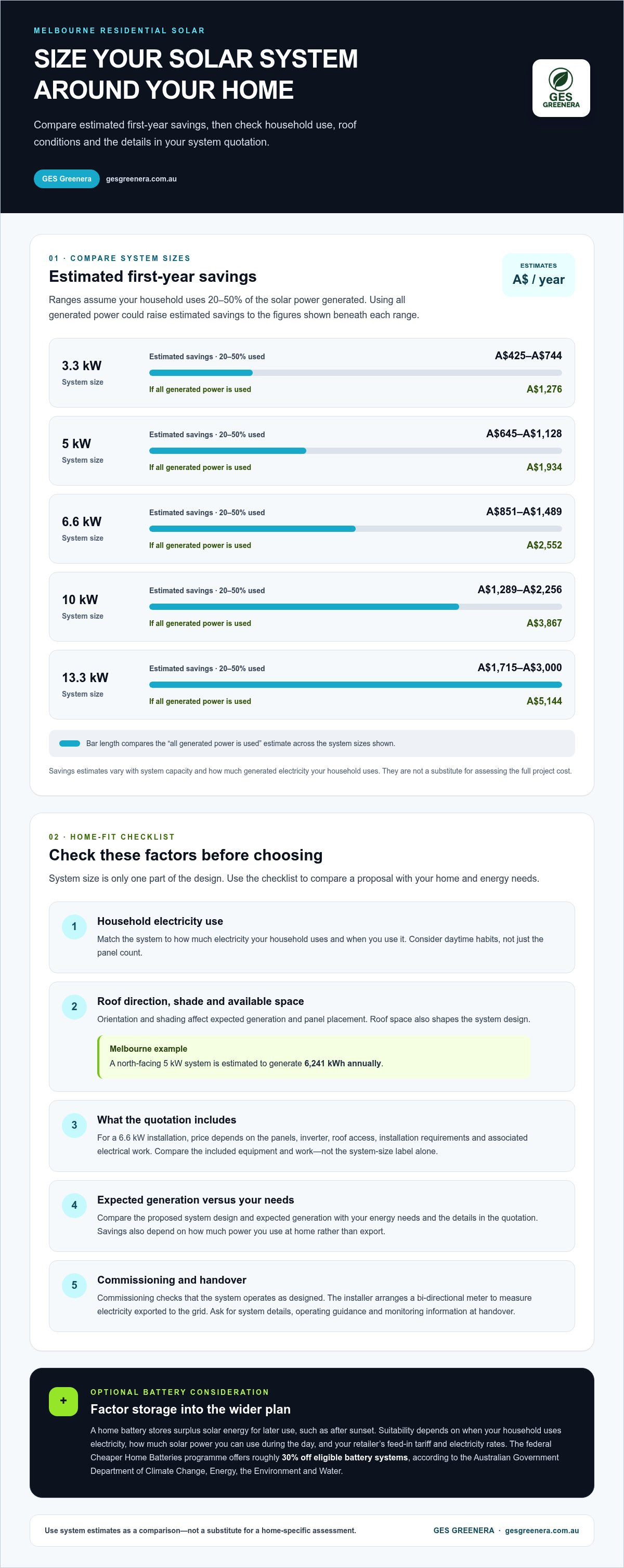
Estimated first-year savings vary with system capacity and how much generated electricity your household uses. Without a battery, estimates are A$425-A$744 for a 3.3 kW system, A$645-A$1,128 for 5 kW, A$851-A$1,489 for 6.6 kW, A$1,289-A$2,256 for 10 kW and A$1,715-A$3,000 for 13.3 kW. These ranges assume 20-50% of solar power is used. Using all generated power could raise estimated first-year savings to A$1,276, A$1,934, A$2,552, A$3,867 and A$5,144 respectively.
6.6KW system price estimates
A specific 6.6 kW installation price depends on the panels, inverter, roof access, installation requirements and any associated electrical work. A quotation should detail these components rather than rely on a system-size label alone. Compare the included equipment and work, then consider how the design suits your home’s electricity use. Savings estimates are not a substitute for assessing the full project cost.
System design starts with your electricity use and budget. Roof orientation, shading and available space affect panel placement and expected generation. A 6.6 kW system’s estimated savings also depend on how much power you use at home rather than export. The federal Cheaper Home Batteries program offers roughly 30 percent off eligible battery systems from 1 July 2025, according to the Australian Government Department of Climate Change, Energy, the Environment and Water.
After installation, commissioning checks that the solar system operates as designed. The installer also arranges a bi-directional meter to measure electricity exported to the grid. During handover, ask for the system details, operating guidance and monitoring information. Ongoing support can help with questions about performance or electrical issues as your household’s needs change.
Poor-quality installation can leave panels underperforming or create electrical and safety risks. Reduce these risks by using an authorised retailer, such as GES Greenera, and ensuring commissioning checks and grid connection steps are completed before relying on the system.
How do Commercial & Residential solar panels in Melbourne work?
A solar system converts sunlight into electricity, and an inverter makes that electricity usable in your home. A site assessment considers roof direction, shading and suitable equipment to inform the system design.
Roof orientation and panel tilt
North-facing panels generally capture strong sunlight across the day in Melbourne. East- or west-facing panels may produce about 10-20% less output than north-facing panels, so the roof’s layout helps shape the design. Solar panels can also generate electricity from diffused daylight on cloudy days. Flat roofs need tilt frames to angle panels towards the sun.
Panel and inverter installation
Installers secure panels to suitable roof sections, then connect them to an inverter. The inverter converts the panels’ direct current into alternating current for household use. A package’s specifications can include panel wattage, inverter type and product or performance warranty terms. For example, a listed Melbourne bundle includes 440 W N-type Tier 1 panels with a 30-year warranty. Compare specifications, not brand names alone.
Installation timeframe
Residential solar panel installation in Melbourne usually takes a few days, depending on system size. The work includes mounting panels, wiring the inverter and completing electrical checks. After installation, the installer arranges a bi-directional meter to measure electricity exported to the grid. Commissioning confirms system operation, while the meter connection supports export measurement.
A home battery stores surplus solar energy for later use, such as after sunset. Whether it suits your household depends on when you use electricity, how much solar power you can use during the day, and your retailer’s feed-in tariff and electricity rates. Review the battery’s storage capacity and operating specifications to see how it fits your energy needs.
Panel and inverter brands vary, so compare their specifications and warranty terms with the proposed system design. A practical solar system design accounts for roof orientation, shading and household energy use, rather than selecting equipment by brand alone.
What solar rebates are available in Victoria?
Victoria’s solar support can include rebates, loans and federal incentives. Check the relevant programme’s eligibility criteria and how they apply to your property before planning an installation.
Victorian rebates and interest-free loans
Solar Victoria lists a maximum solar PV rebate of A$1,400 for eligible households. For eligible rental properties, it lists a Victorian solar rebate of up to A$1,400. Eligible Victorian households can also apply for an optional interest-free loan of up to A$1,400 for solar panels, according to Solar Victoria. These are separate support options, so identify which programme fits your household or rental property.
Eligible households may be able to access support for battery systems. The federal Cheaper Home Batteries programme offers roughly 30% off eligible battery systems. Compare eligibility, rebate conditions and the battery’s role in your energy use before adding it to a solar plan.
Solar Victoria rebate assistance
Start by comparing your property and proposed system with the relevant Solar Victoria eligibility criteria. Keep the system quotation and installation details with your rebate paperwork for easy reference during an application. The system design should show panel capacity and equipment details, so you can understand what the proposed rebate relates to.
Generation estimates help households compare system sizes. A north-facing 3 kW system in Melbourne is estimated to generate 3,686 kWh annually; a 5 kW system, 6,241 kWh annually; and a 10 kW system, 12,300 kWh annually. Roof orientation influences generation, so these examples provide context rather than a design for every home.
Federal small-scale technology certificates (STCs) can contribute a discount for solar installations under 100 kW, described as usually about 30% of total installation cost. In Victoria, residential solar installations are generally exempt from planning permits under deemed-to-comply provisions when standard roof-edge setbacks are met. Check how the roof layout affects those setbacks during planning.
Melbourne solar installation and site assessments
A site assessment checks roof suitability, orientation and shading before the system is designed. These factors affect how much electricity the panels can generate and the savings they may support.
Roof suitability and orientation checks
The assessment considers roof direction, usable space and obstructions that could limit panel placement. North-facing panels generally produce strong output, but east- or west-facing roof sections may also suit a system layout. The installer reviews the roof’s condition and your household’s energy needs, using all these details to guide the design rather than relying on roof direction alone.
Roof types and structural checks
Roof materials and construction affect how panels can be mounted. Tile and metal roofs need suitable attachment methods, and the structure must support the proposed equipment. Older Melbourne homes may need a roof-condition assessment before installation. Raising any roof repairs early helps clarify the installation scope and whether the planned panel layout suits the existing structure.
Site assessment pricing factors
The assessment informs a quotation by identifying the panels, installation work and associated costs required for the home. Factors include roof access, panel placement, electrical work and any site-specific requirements. Ask for these details to be itemised, so you can understand what the proposed system includes. Required local council permits and approvals are considered before installation where applicable.
Shading checks
Trees, nearby buildings and roof features can shade panels and affect generation. The assessment considers where and when shadows fall to guide panel placement. Power optimisers or microinverter systems may help manage partial shading. A well-considered design accounts for shaded roof areas while keeping your household’s electricity needs in view.
For a roof-specific system assessment and solar PV installation, discuss the roof layout, shading and electrical requirements as part of the project.
GES Greenera: Residential Electrical Repairs
GES Greenera installs solar PV systems for households planning a new system and provides residential electrical repairs for electrical issues that need attention. If you’re considering solar, its installation service brings the system design and electrical work together with your home’s energy needs.
For related upgrades, GES Greenera also installs EV charging stations. Commercial switchboard upgrades are for businesses, while residential electrical repairs address household electrical faults separately from a solar project. For adding panels at home, solar installation is the relevant service.
Discuss your home’s solar plans or electrical requirements with GES Greenera to decide on a suitable next step. Contact GES Greenera for a free, no-obligation quotation.
Take the next step towards solar
Before moving ahead, prepare a brief about your home and priorities. Note your electricity-use patterns, planned changes such as an electric vehicle, and questions about how solar could suit your household. This can make a discussion about residential solar installation in Melbourne more focused on your needs.
GES Greenera installs solar PV systems for households planning a solar upgrade and provides residential electrical repairs for household electrical issues. Commercial switchboard upgrades are a separate service for businesses planning electrical improvements. Start by identifying the work your property needs, then choose the relevant service.
Discuss your solar project or residential electrical requirements with GES Greenera to explore a suitable next step. Contact GES Greenera to start the conversation and move your plans forward with confidence.
Frequently Asked Questions
How much can I save with solar power in Melbourne?
Estimated first-year savings for a 5 kW system are A$645-A$1,128 without a battery, while a 10 kW system is estimated at A$1,289-A$2,256. These estimates assume 20-50% of solar power is used at home. Actual bill savings depend on how much electricity you use directly and how much you export.
What are the benefits of installing a residential solar system?
Solar lets your home generate electricity, which may reduce how much power you buy from the grid. Using appliances during sunny periods, such as running the dishwasher during the day, can help you use more of your solar generation at home. A battery can store surplus electricity for later, but whether it suits you depends on your household’s usage patterns.
What type of solar panels should I install in Victoria?
Choose panels by considering available roof space, orientation, expected output and how they pair with the inverter. Compare the equipment specifications and warranty terms in the proposed system, rather than choosing by brand name alone. One Melbourne solar and battery bundle lists 440 W N-type Tier 1 panels with a 30-year warranty, offering a concrete specification to compare.
What is the average cost of residential solar installation in Melbourne in 2026?
The project cost depends on system capacity, panel and inverter specifications, roof access and any associated electrical work. A single average may not reflect the system suited to your home. A detailed quotation should set out the proposed equipment, installation work and other costs, so you can compare the scope and understand what the system includes.
What rebates and incentives are available for Melbourne homeowners installing solar panels?
Solar Victoria lists a maximum solar PV rebate of A$1,400 for eligible households, and eligible households can apply for an optional interest-free loan of up to A$1,400 for panels. Eligible rental properties may also qualify for a Victorian rebate of up to A$1,400, according to Solar Victoria. Federal support is also available for eligible home batteries.
How much can a typical Melbourne household save with rooftop solar?
A 6.6 kW system is estimated to save A$851-A$1,489 in its first year without a battery. The estimate rises to up to A$2,552 when all solar power is used. The key practical factor is matching generation with household demand: using more electricity while panels are producing can reduce reliance on grid power.


