

Could the most sophisticated climate-control system be the wrong choice for your Melbourne home? VRV air conditioning offers independent room-by-room control, which can be useful when different spaces have different comfort needs. But more zoning doesn’t automatically make it the most practical option for every property.
If you’re weighing up VRV against ducted or multi-split air conditioning, the key question is whether the extra control suits your layout and routines. This guide explains how the system works and clarifies the difference between VRV, Daikin’s trademark, and VRF, the generic industry term. You’ll compare zoning, comfort and energy use, then consider how room use, equipment locations, pipe routes and electrical requirements affect the decision. GES Greenera provides air conditioning solutions alongside residential and commercial electrical services, supporting a practical approach to your property’s climate-control needs.
Key Takeaways
- Understand how VRV systems distribute heating and cooling, and what the VRV and VRF terms mean.
- Compare zoning and layout considerations to narrow down whether VRV, ducted or multi-split better fits your home.
- Assess room use, equipment placement, pipe routes and noise before settling on vrv air conditioning.
- See how GES Greenera’s air conditioning solutions can support a system suited to your property.
What Is VRV Air Conditioning, and When Does It Suit a Melbourne Home?
VRV stands for Variable Refrigerant Volume. The system adjusts how much refrigerant moves between an outdoor unit and multiple indoor units to respond to heating or cooling demand in different areas. VRV is Daikin’s trademark; Variable Refrigerant Flow (VRF) is the generic term for this type of technology.
One outdoor unit can serve several indoor units, but the number, type and arrangement depend on the system design. This setup can allow different temperature settings in separate rooms. It doesn’t guarantee lower energy use or better comfort by itself. Outcomes also depend on equipment selection, controls, installation quality and how the household operates the system.
How VRV air conditioning works across multiple rooms
Refrigerant carries heat between the indoor and outdoor equipment. Inverter control lets the system adjust its operation to changing demand, rather than running at one fixed output. Each indoor unit can be controlled for its own room or zone, so an occupied living area and an unused bedroom don’t always need the same settings. The exact configurations and capabilities vary by manufacturer and design.
Which Melbourne homes may benefit from VRV?
VRV may be worth considering in a larger or multi-zone home where household members use different rooms at different times, or where independent temperature control is a priority. For example, a household could condition the living area during the day and set bedrooms separately in the evening.
That level of control may be unnecessary in a compact home with a straightforward layout or only a few rooms needing heating or cooling. To judge the fit, consider which rooms need conditioning, where indoor units could go and whether there’s a practical route for the connecting pipework. A site-specific assessment helps establish whether VRV air conditioning suits the property, rather than assuming a more advanced system is automatically the better choice.
VRV, Ducted or Multi-Split: Which Air Conditioning System Fits?
The right system depends on your home’s layout, the rooms you want to condition and how much control you need over each space. Use this comparison to narrow down the options before considering installation details.
| System | Zoning and layout | Typical consideration |
|---|---|---|
| VRV | Multiple indoor units can allow separate room controls. | Needs planning for equipment, pipe routes and controls. |
| Ducted | Conditioned air travels through ducts from a central system; zones may be controlled centrally. | Ceiling or other suitable space is needed for ductwork. |
| Multi-split | Multiple indoor units connect to an outdoor unit, with control options depending on the design. | Consider indoor-unit locations and how rooms are used. |
VRV versus ducted air conditioning
VRV uses separate indoor units, while ducted systems distribute air through concealed ducts and outlets. Ducted may suit a home where a less visible, whole-home approach is preferred and there’s space for ductwork. VRV may suit a layout where independent room control matters, although the indoor units remain visible. Explore this ducted air conditioning Melbourne installation guide and reverse cycle air conditioning Melbourne homeowner guide for more context.
VRV versus multi-split systems
Both systems can connect multiple indoor units, but their available configurations and controls differ. A multi-split may suit a smaller group of rooms, while VRV may be worth considering when more tailored zoning is a priority. Room count alone won’t settle the decision. Compare household routines, possible indoor-unit locations and installation constraints. This technical overview of VRF systems provides further background.
A property-specific design helps match the system to your home. Explore GES Greenera’s air conditioning solutions as you consider your options.
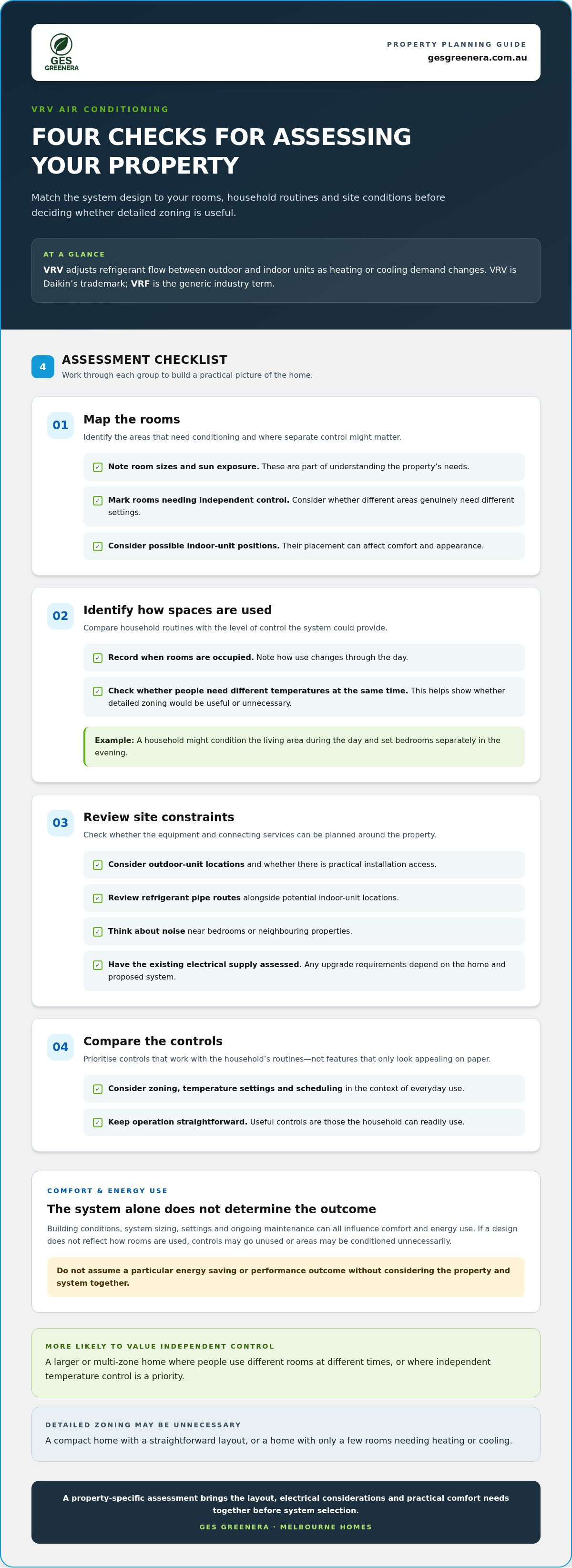
How to Assess VRV Air Conditioning for Your Property
A practical assessment connects the system design to your home and daily routine. Use these four steps to organise the key questions:
- Map the rooms. Note room sizes, sun exposure and which areas need independent control. Mark potential indoor-unit locations and consider how their position may affect comfort and appearance.
- Identify how spaces are used. Record when rooms are occupied and whether household members need different temperatures at the same time. This helps show whether detailed zoning would be useful or unnecessary.
- Review site constraints. Consider potential outdoor-unit locations, refrigerant pipe routes, installation access and noise near bedrooms or neighbouring properties. Have the existing electrical supply assessed too, as any upgrade requirements depend on the home and proposed system.
- Compare controls. Consider how zoning, temperature settings and scheduling could work with your household’s routines. Prioritise controls that are straightforward to use, rather than features that only look appealing on paper.
What shapes comfort and energy use?
Room size and occupancy are only part of the picture. Building conditions, system sizing, settings and ongoing maintenance can all influence energy use and comfort. If a design doesn’t reflect how rooms are used, controls may go unused or areas may be conditioned unnecessarily. Don’t assume a particular energy saving or performance outcome without considering the property and system together.
Planning should also account for applicable Victorian installation and electrical requirements. These details can change, so check current requirements during project planning rather than relying on a general guide. A property-specific assessment brings the layout, electrical considerations and practical comfort needs together before you select vrv air conditioning.
GES Greenera provides air conditioning solutions for homes and businesses. Explore air conditioning options for your property.
Planning VRV Air Conditioning Installation with GES Greenera
Good system planning starts with how you want your home to feel and function, not equipment selection alone. GES Greenera provides air conditioning solutions and electrical services, giving you a practical place to begin when considering climate control and the property’s electrical requirements.
What to prepare before planning an installation
A little preparation can make it easier to compare system options. Note:
- Which rooms you want conditioned and where independent temperature control matters.
- Your comfort priorities and the times different areas are usually occupied.
- Any existing heating or cooling equipment, plus relevant electrical or property details.
- Planned renovations, access constraints and preferred positions for indoor units.
These details help focus the site assessment on practical questions, such as possible outdoor-equipment locations, pipe routes and access around the home. Mention renovation plans early so system planning can take other property work into account.
What to expect from a tailored system plan
System planning brings together your needs, the site conditions and a suitable configuration. Layout, zoning priorities, equipment placement, pipe routes and existing electrical infrastructure all affect the design. Any electrical upgrade requirements depend on the property and proposed system, so they need to be assessed rather than assumed in advance.
Equipment selection should reflect the rooms being conditioned and how your household will use them. A considered configuration can support practical control and comfortable operation, while energy use still depends on factors such as settings, building conditions and maintenance. There’s no one-size-fits-all answer: a vrv air conditioning plan needs to suit the home.
GES Greenera’s air conditioning solutions provide a practical starting point for planning climate control around your property. Explore GES Greenera’s air conditioning solutions.
Choose a System That Fits Your Home
The best choice isn’t automatically the most advanced one. VRV air conditioning can suit homes where independent room control is valuable, while ducted or multi-split systems may better match other layouts and comfort priorities. Compare how your household uses each space, then factor in equipment placement, pipe routes, available electrical supply and installation conditions.
A property-specific plan helps align the system with everyday comfort and practical operation. GES Greenera provides residential and commercial electrical services, including air conditioning solutions as part of its wider energy and climate services. This gives you a practical starting point for considering both climate control and your home’s electrical requirements.
Ready to explore options for your property? Explore GES Greenera’s air conditioning solutions and take the next step towards a more comfortable home.
Frequently Asked Questions
What is VRV air conditioning?
VRV air conditioning adjusts refrigerant flow to meet heating or cooling demand across multiple indoor units. Each unit can serve a separate room or zone, allowing different areas to have individual settings, depending on the system design. VRV is Daikin’s trademark for this technology; VRF, or Variable Refrigerant Flow, is the generic industry term.
Is VRV air conditioning suitable for a house?
VRV can suit a house where independent control across several rooms is a priority. It may be worth assessing for larger homes or layouts where household members use different areas at different times. Suitability depends on room use, equipment locations, pipe routes, electrical requirements and installation conditions. A property assessment helps determine whether the zoning benefits make sense for your home.
What is the difference between VRV and VRF air conditioning?
VRV and VRF refer to the same general type of air conditioning technology, which varies refrigerant flow to meet demand. VRV is the trademarked term used by Daikin, while VRF, meaning Variable Refrigerant Flow, is the generic term used across the industry. Features and configurations can vary between manufacturers, so the terms alone don’t establish how a particular system will perform.
Is VRV air conditioning more efficient than ducted air conditioning?
Not automatically. Efficiency depends on the equipment, system design, installation, controls and how the household uses it. VRV can provide separate room control, while ducted systems distribute conditioned air through ducts and may use centralised zoning. Compare the home’s layout, which rooms need conditioning and the system’s operating settings rather than assuming one option will always use less energy.
How long does VRV air conditioning installation take?
There’s no single installation timeframe for every home. Timing depends on the system configuration, the number and placement of indoor units, pipe routes, site access and any electrical work identified during assessment. GES Greenera serves Melbourne-area locations including Melton, Melbourne Airport, Diggers Rest, Deanside, Bacchus Marsh, Sunbury, Sunshine, Altona, Williamstown, Essendon, Thomastown, Epping, Eynesbury and Werribee.


