

Will ducted air conditioning suit your Melbourne home, or will it condition rooms you rarely use? The answer depends on your home’s layout and your household routine, not just the system itself. Before deciding, consider installation access, running costs and zoning. A search for “ducted air conditioning melbourne” should lead to practical planning, not guesswork.
This guide explains how ducted reverse-cycle systems work and how they differ from ducted heating, so you can compare your options with confidence. You’ll learn which details of your home affect system design, what to consider when planning installation, and how zoning can match comfort to the way you use each space. With a considered approach, you can take a clearer, more energy-conscious step towards year-round comfort.
Key Takeaways
- See how ducted reverse-cycle systems differ from heating-only options, and whether whole-home coverage suits your household.
- Learn how zoning can match temperature control to the rooms you use and your daily routine.
- Use a practical planning sequence to consider room needs, duct and unit locations, and installation access.
- Compare ducted air conditioning melbourne options with split systems to identify which approach best fits your home.
Is ducted air conditioning in Melbourne right for your home?
Ducted air conditioning is a central system that conditions air and distributes it through concealed ductwork to outlets in different rooms. A reverse-cycle ducted system can provide both heating and cooling through one system. Separate split systems give direct control over individual rooms, while ducted heating-only systems are designed to heat, not cool. The wider principles of Heating, Ventilation, and Air Conditioning (HVAC) also involve how comfort, energy use and system design work together.
Ducted air conditioning or ducted heating: what is the difference?
Reverse-cycle ducted air conditioning moves heat in or out of the home, so the same system can warm rooms in winter and cool them in summer. Ducted heating distributes warm air through ducts but doesn’t provide cooling. Although both use central air distribution, they aren’t interchangeable. When comparing ducted air conditioning in Melbourne, start by deciding whether you need both heating and cooling or heating alone.
Which Melbourne homes may benefit from ducted comfort?
Ducted comfort may suit households that regularly use several rooms and want a consistent approach across the home. For example, a family might use living areas during the day and bedrooms at night, and prefer to manage those areas through one system rather than rely on a separate unit in each room. Whole-home coverage isn’t automatically the best fit for every property, though.
Check these practical factors:
- Layout: The arrangement of rooms affects how air can be distributed.
- Ceiling space: Ductwork and system components need suitable space and access.
- Existing services: Electrical capacity and other existing services can shape installation planning.
- Routine: List the rooms you use and when you use them to judge whether central coverage makes sense.
Considering these factors together helps clarify whether ducted air conditioning suits your home or whether room-based control better fits the way you live.
How Melbourne ducted air conditioning delivers heating, cooling and zoning
In a ducted system, conditioned air travels from the central unit through insulated ductwork and enters rooms through ceiling or wall outlets. With a reverse-cycle system, the unit can provide warm or cool air as needed. A return-air pathway carries air back through the system to help it circulate around the home.
Ducted zoning divides a home into controllable areas, so households can direct heating or cooling to the spaces they’re using. The zones and controls need to suit the home’s layout and the system design to support everyday comfort.
How zoning can match different rooms and routines
A household might use living areas during the day and bedrooms overnight. Separate zones can let occupants choose which areas receive conditioned air at different times, rather than treating the whole home as one space. Before deciding how to group rooms, consider your regular routine and which areas are occupied at the same time. The available controls and zone layout depend on the system and property.
What affects comfort and energy use?
Insulation, room size and how spaces are used all influence how quickly a room warms or cools. Melbourne’s seasonal changes can also mean different demands across the year. Thermostat settings matter too: choose a comfortable target and avoid extreme settings that make the system work harder than necessary. The Australian Government’s guide to home heating and cooling offers further context on making considered choices for Australian homes.
An inverter adjusts the system’s output to meet heating or cooling demand, rather than relying only on repeated full-power starts and stops. It can support more measured operation, but energy use still depends on system design, home conditions and how occupants use the controls. For ducted air conditioning melbourne households, planning zones around actual room use is a practical way to work towards balanced comfort. GES Greenera provides air conditioning solutions tailored to the home and its comfort needs.
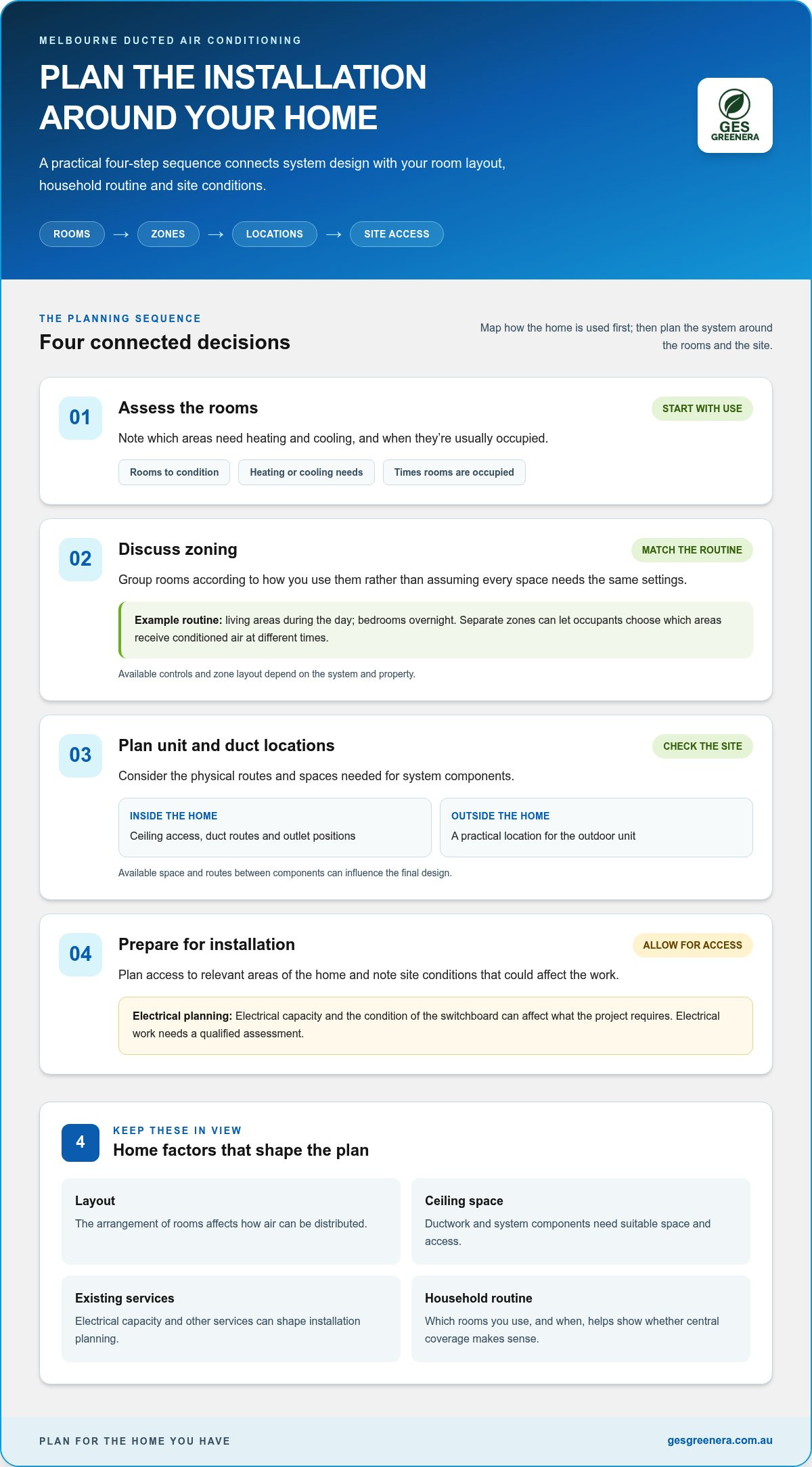
How to plan ducted air conditioning installation in Melbourne
A considered plan connects the system design to your home’s layout and daily routine. Before settling on ducted air conditioning in Melbourne, map the rooms you want conditioned and note how the household uses them. For broader system context, read our Melbourne reverse-cycle air conditioning guide.
- Assess the rooms: Note which areas need heating and cooling, and when they’re usually occupied.
- Discuss zoning: Group rooms according to how you use them rather than assuming every space needs the same settings.
- Plan unit and duct locations: Consider ceiling access, duct routes, outlet positions and a practical location for the outdoor unit.
- Prepare for installation: Plan access to relevant areas of the home and note site conditions that could affect the work.
What should be considered before installation?
Mapping the rooms gives the system design a useful starting point. Mark preferred outlet positions and identify anything that may affect duct routes, such as limited ceiling access or differences in the home’s layout. Consider where the outdoor unit could go as well. These decisions are connected: available space and the routes between system components can influence the final design, so plan for the whole site.
How electrical planning fits into the project
Electrical capacity and the condition of the switchboard can affect what the project requires. These details are considered alongside the system and site conditions to help shape an appropriate installation plan. Electrical work needs a qualified assessment. For more on household electrical considerations, see the Melbourne residential electrician guide.
GES Greenera provides air conditioning solutions tailored to the home and its electrical requirements. Explore air conditioning solutions for your home.
Choose a Melbourne ducted air conditioning solution that fits your home
The right fit depends on how much of your home you want to condition, whether you need heating as well as cooling, and how much control you want over individual rooms. Use this comparison to narrow your options, then weigh your home’s layout and energy-conscious operation alongside project considerations.
| System | Coverage | Room control | Heating and cooling | Installation considerations |
|---|---|---|---|---|
| Whole-home ducted | Multiple rooms through ducts and outlets | Can be divided into zones, depending on design | Reverse-cycle models provide both; other configurations may vary | Needs suitable space for duct routes and system components |
| Room-based split systems | Selected rooms or areas | Each indoor unit controls its own space | Depends on the system selected | Indoor and outdoor unit locations need planning for each area |
| Ducted heating-only | Multiple rooms through ductwork | Control depends on system setup | Heating only | Requires suitable duct routes and access for installation |
Which system features matter most to your household?
If you want broad coverage and the option to manage areas separately, ducted reverse-cycle air conditioning may suit your routine. Split systems can suit homes where comfort is needed in selected rooms, while heating-only ducted systems won’t provide summer cooling. Compare these differences with your home’s layout and how you plan to operate the system. The right ducted air conditioning Melbourne solution should reflect how your household uses its spaces, not simply the number of rooms.
Plan your next step with a local Melbourne team
Before discussing options, note your home layout, the rooms you use most, any existing heating or cooling system, and your comfort priorities. These details help shape a practical discussion about air conditioning and related electrical requirements. GES Greenera provides home comfort solutions across Melbourne, including Melton, Sunbury, Essendon and Werribee.
Explore GES Greenera’s home comfort solutions and discuss a tailored option for your home.
Take the next step towards home comfort
A suitable ducted system starts with your home, not a catalogue. Consider which rooms need heating and cooling, how your household uses them, and whether zoning will help manage comfort across different areas. It’s also useful to distinguish reverse-cycle ducted air conditioning, which can heat and cool, from ducted heating-only systems.
For ducted air conditioning melbourne homeowners, installation planning should bring together the home’s layout, ceiling access, outlet and outdoor-unit positions, and electrical requirements. These details help shape a solution that fits the property and supports energy-conscious use.
GES Greenera brings air conditioning solutions and residential electrical services together, tailoring the approach to your home. Local service areas include Melton, Sunbury, Sunshine, Essendon and Werribee.
Ready to explore your options? Discuss a tailored home comfort solution with GES Greenera. A clear plan is a practical first step towards year-round comfort.
Frequently Asked Questions
Is ducted air conditioning worth installing in a Melbourne home?
It can be worthwhile if you want heating and cooling across multiple rooms and your home can accommodate central ductwork. A reverse-cycle system can provide both, while zoning may help match operation to different routines. Suitability also depends on ceiling access, existing services and whether you regularly use enough areas to justify whole-home coverage. Compare these factors with separate split systems. People searching “ducted air conditioning melbourne” should focus on how well a system fits the home, rather than on labels.
Can ducted air conditioning also heat a home?
Yes, if it’s a reverse-cycle ducted air conditioning system. It can transfer heat into the home in cooler weather and remove heat for cooling in warmer weather, using the same central system and ductwork. A ducted heating-only system is different: it supplies heat but doesn’t provide cooling. Check the system type when comparing options, since the term “ducted” alone doesn’t tell you whether cooling is included.
How does zoning work in ducted air conditioning?
Zoning divides a home into areas that can be controlled separately, allowing conditioned air to be directed to selected spaces. For instance, a household might prioritise living areas during the day and bedrooms overnight. The number and arrangement of zones depend on the home and system design. Planning around which rooms you use, and when, helps make zone control more practical.
How long does ducted air conditioning installation take?
There isn’t one fixed installation timeframe; it depends on the home and project scope. Ceiling access, duct routes, outlet positions, outdoor-unit location, electrical requirements and household access can all affect scheduling. GES Greenera provides air conditioning solutions and electrical services in Melton, Melbourne Airport, Diggers Rest, Deanside, Bacchus Marsh, Sunbury, Sunshine, Altona, Williamstown, Essendon, Thomastown, Epping, Eynesbury and Werribee.
Are Victorian energy rebates available for ducted air conditioning in 2026?
Potentially. The Victorian Energy Upgrades (VEU) program offers discounts for some energy-efficient reverse-cycle air-conditioning upgrades, but eligibility and discount amounts depend on factors such as the existing system and the new system’s efficiency. Not every ducted installation will qualify. Check the current VEU criteria before including an incentive in your budget, and treat any discount as conditional on the project meeting program requirements.


